
Can I start with one battery and expand later?
Yes, and it is one of the more practical reasons to choose modular hardware. If you may want to expand a home battery later, the two questions that decide your options are these. One is how the units link together, and the other is how many of them the system supports.
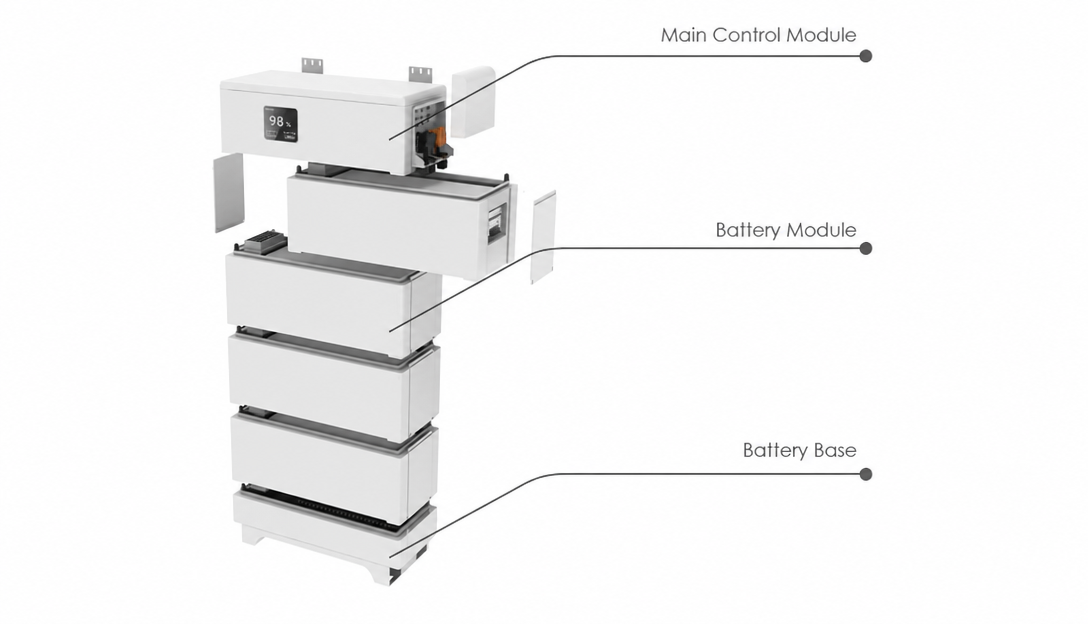
Two ways to expand a home battery later
The first is modular growth within a single unit. Stackable systems use 5.12 kWh modules. Two modules give 10.24 kWh, and the stack scales to 30.72 kWh at six modules. You buy the enclosure once and add capacity as your needs change.
The second is parallel expansion across units. Our wall-mounted and floor-mounted ranges support up to 64 units running in parallel, communicating over CAN, RS485 or RS232. That covers growth from a single essential-load backup unit. It takes you up to a system carrying substantially larger loads, the whole point of battery expansion.
What to plan for at installation time
Battery expansion is cheaper if you plan for it on day one. Reserve wall or floor space for the additional enclosures. Size the cable runs and breaker for the final configuration, not the initial one. Also make sure the inverter you choose can handle the final charge and discharge current.
It is also worth confirming how addressing works, because battery expansion depends on it. Parallel systems use address settings to identify each unit. On the floor-mounted all-in-one cabinets, DIP switches plus an RJ45 Ethernet link handle this. Getting the addressing convention clear at the start saves time on the day you add a unit. It also keeps battery expansion simple.
Choosing hardware that does not box you in
For expandable battery storage, look for published parallel limits and published module sizes rather than marketing phrases about scalability. Compare the current ratings too. Adding capacity is straightforward. However, if the inverter cannot pass enough current, the extra kilowatt-hours will not translate into more usable power. That is a practical limit on expandable battery storage.
We list the current specifications on the stackable, wall-mounted and floor-mounted pages. We also collect the datasheets on our resources page. The requirements covering how expandable battery storage systems undergo testing and rating come from UL Solutions. Tell us your five-year plan and we will map the growth path for you — contact our engineers.
Questions about anything on this page?
Send us your load list, your inverter model or a photo of the nameplate. Our engineers review the details and confirm what fits your site.
- Single-line diagram or load schedule
- Inverter make and model
- Photo of the nameplate or your existing battery
Prefer email? Write to admin@rdsmod.com