For most households the answer is yes. Our published compatibility figure is 99%, and the units pair with virtually all hybrid inverter brands. But home battery inverter compatibility is worth understanding properly. The pairing is a two-part question: physical and electrical fit, and communication.

For inverter compatibility, nominal voltage and the number of series cells have to match. Check what your inverter expects from a lithium battery. Our units use a 16S1P LiFePO4 configuration, which is the common residential arrangement, so this is rarely the obstacle.
Continuous current is where mismatches actually appear. The 5 kWh unit takes 50 A continuous charge and delivers 100 A continuous discharge. The 10 kWh unit takes 100 A and delivers 200 A. The 16 kWh unit takes 150 A and delivers 300 A. If your inverter can pass more current than the battery can accept, the inverter becomes the limiting device. The available capacity then will not translate into the power you expected.
Hybrid inverter pairing is completed over CAN, RS485 or RS232, depending on what your inverter accepts. Once you set the protocol and addressing, the battery reports state of charge, power and status to the inverter. That lets the inverter control charge and discharge properly.
In practice this is the step where installers spend their time, because each inverter brand implements its battery profile differently. Correct protocol settings and pin-out, ready before the visit, turn a compatibility claim into a working system.
Send us your inverter make and model and we will confirm the protocol settings. We publish the electrical specifications on the wall-mounted and floor-mounted product pages. Our datasheets on the resources page list the supported interfaces. Note that for expandable systems, inverter compatibility is separate from expandability. Our units support up to 64 in parallel. A confirmed pairing today can therefore grow into a larger bank later. General background on home energy systems comes from the U.S. Department of Energy.
For the expansion path itself, see our guide to expanding a home battery later.
Is AC-coupled or DC-coupled the right fit for your existing solar setup?
Choosing a home battery capacity is really a question about load and cycle life, not about budget alone. All three capacities share the same cell platform and the same battery management system. The choice therefore comes down to how much energy you need, how much current your inverter demands, and how hard the battery will be worked. That holds whichever storage capacity you pick.

Every unit in the range uses Grade A LiFePO4 cells from EVE, CATL or GOTION in a 16S1P configuration. A smart BMS provides 18-layer protection. It covers over and under voltage, charge and discharge overcurrent, short circuit and low-temperature charge protection. It also covers high-temperature discharge protection, cell balancing, temperature monitoring and fault alarms.
They also share the same communication set — CAN, RS485 and RS232. The same inverter pairing therefore works across the range, whatever battery capacity options you pick. In contrast, what changes is capacity, current rating and published cycle life.
The 5 kWh unit carries a published cycle life of 6,000 cycles or more at 25°C. Its maximum continuous charge current is 50 A, and its discharge current is 100 A. It suits essential-load backup and smaller solar self-consumption setups, where the smaller battery capacity options fit.
The 10 kWh and 16 kWh units carry a rating of 8,000 cycles or more at 25°C. Their maximum continuous charge currents are 100 A and 150 A, and their discharge currents are 200 A and 300 A respectively. In addition, the higher discharge ratings matter if you want to run heavy loads or a larger inverter. That holds across the storage capacity options.
For instance, match the capacity to your measured overnight load first. Then check the current rating against your inverter’s continuous output, not storage capacity alone. If both fit a smaller unit but you expect to add loads later, remember one thing. All of these formats support parallel expansion, up to 64 units. The stackable range grows in 5.12 kWh steps from 10.24 kWh to 30.72 kWh, so storage capacity can grow with the load.
See the full specification tables for every storage capacity on the wall-mounted and floor-mounted product pages. You can also download the datasheets from our resources page. The relevant safety standard for these systems comes from UL Solutions. Still unsure which capacity suits your house? Send us your load profile.
Yes. If you need to customize a home battery for a specific market or product line, you can re-specify most of it rather than simply relabel it. Our published customization list covers six areas, from the electrical core outwards.

For battery customization, you can adjust capacity and voltage, including full-gradient capacity customization rather than a choice between fixed steps. For order tiers, branding routes and who holds each certificate, see the OEM, ODM and private-label guide; this page stays a list of what can be re-specified. We support non-standard voltages. That matters when an existing inverter fleet expects a nominal voltage outside the common residential range. We can also raise or lower the current rating to match the application.
For battery customization, we can adapt size and outline. Right-angle and arc-corner shapes are available alongside conventional enclosures. We also offer both single-layer and multi-layer stacking options. You can specify mounting structures as wall brackets, floor foot pads, lifting lugs, stacking buckles or slides. It depends on how you will install and handle the unit.
We can brush or anodize the surface treatment. We can also finish it in full-colour powder coating with custom RAL colours, a common request in battery customization. That is usually the fastest way to make a system match an existing product family without changing the electronics.
Branding is the last layer of battery customization and covers custom logos, display interfaces and module designs. The display interface is worth planning early. It is the part of the product your customer interacts with daily.
Two practical notes. First, customization interacts with certification. A change to capacity, cell supplier or enclosure can mean the existing certificates no longer describe the product you are shipping. Confirm the compliance route before committing to a variant. Second, plan the whole range rather than one SKU. Tooling and finish changes are cheaper when you amortise them across a product family. That is standard practice in battery customization.
Tell us what you need . We will come back with feasibility for your custom battery design, tooling implications and lead time. You can see the standard range on our products page and our production capability in about RUIDASIMAI. Standards relevant to customized storage products come from the International Electrotechnical Commission. Start with a specification conversation.
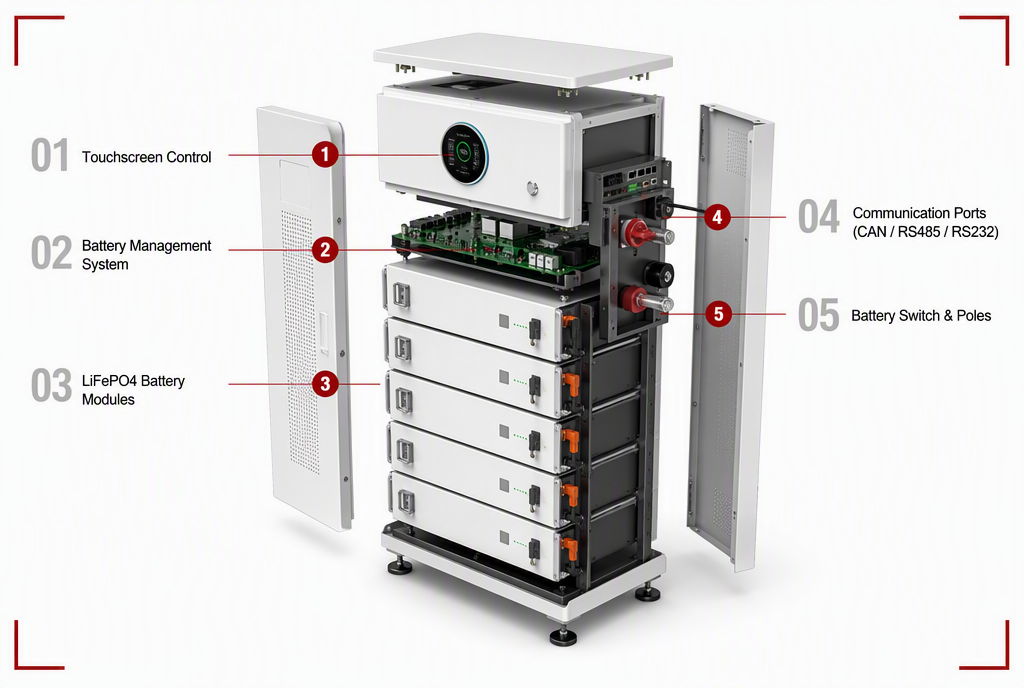
Our residential units support battery communication protocols CAN, RS485 and RS232 as standard, on every capacity. The floor-mounted all-in-one cabinets add RJ45 Ethernet with DIP switch addressing. In short, that combination covers both inverter control and multi-unit coordination.
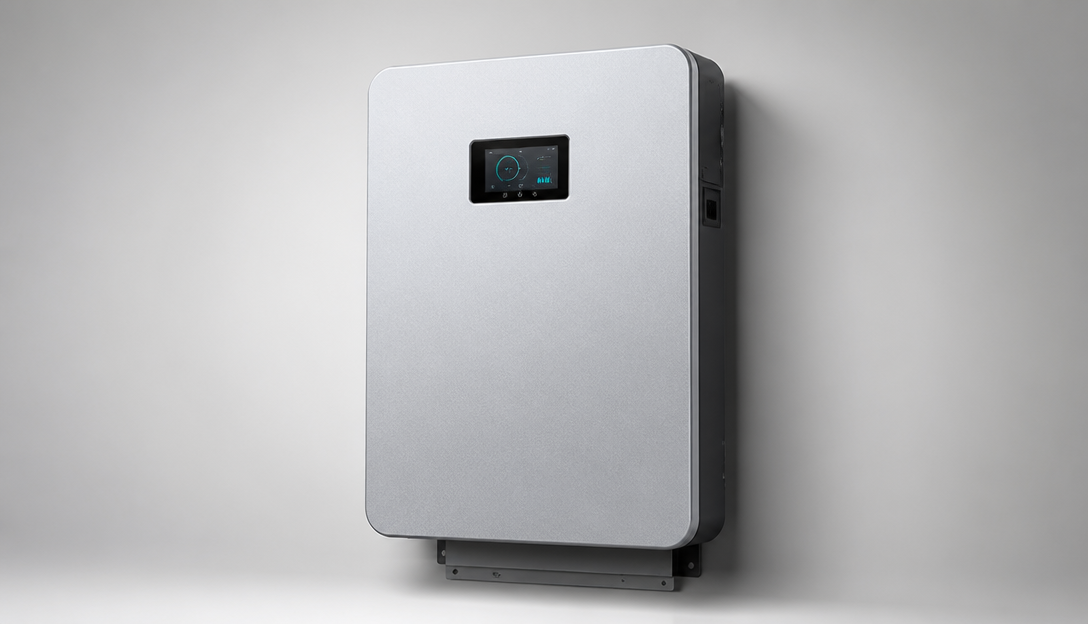
CAN is the workhorse for inverter pairing. It carries the charge and discharge limits, plus state of charge and fault status. For that reason, the inverter needs those to run the battery within specification. Most hybrid inverters implement a CAN battery profile, which is why it is usually the first port connected.
RS485, the second of the common communication protocols, is a longer-distance, multi-drop bus. Installers commonly use it for parallel coordination between units. It also serves monitoring equipment that polls the battery for operational data. RS232 remains in use for service access and for inverters and monitoring devices that still expect a serial connection.
On floor-mounted all-in-one units, RJ45 Ethernet provides the network link between cabinets. DIP switches set the address of each unit. In a large parallel bank, clean addressing stops the master unit from becoming confused about which cabinet it is talking to.
Once you connect these communication protocols, the battery management system reports real-time state of charge, power and status. Each unit also provides a status LED panel and an ON/OFF button for local checks. As a result, the underlying protections all feed into the same reporting stream. That set covers over and under voltage, overcurrent, short circuit, low-temperature charge and high-temperature discharge protection. In addition, it adds cell balancing, temperature monitoring and fault alarms.
We supply protocol documentation with the units and summarise it in our datasheets on the resources page. In addition, we publish the electrical ratings on the stackable, wall-mounted and floor-mounted pages.
Tell us your inverter model and the size of the bank you are planning. We will then confirm which communication protocols and addressing scheme to use. If you are planning a multi-unit installation, ask for the parallel wiring and addressing guide at the same time. Standards for industrial communication and battery testing come from the International Electrotechnical Commission. Ready to specify a system? Contact our engineers.
Yes, and it is one of the more practical reasons to choose modular hardware. If you may want to expand a home battery later, the two questions that decide your options are these. One is how the units link together, and the other is how many of them the system supports.
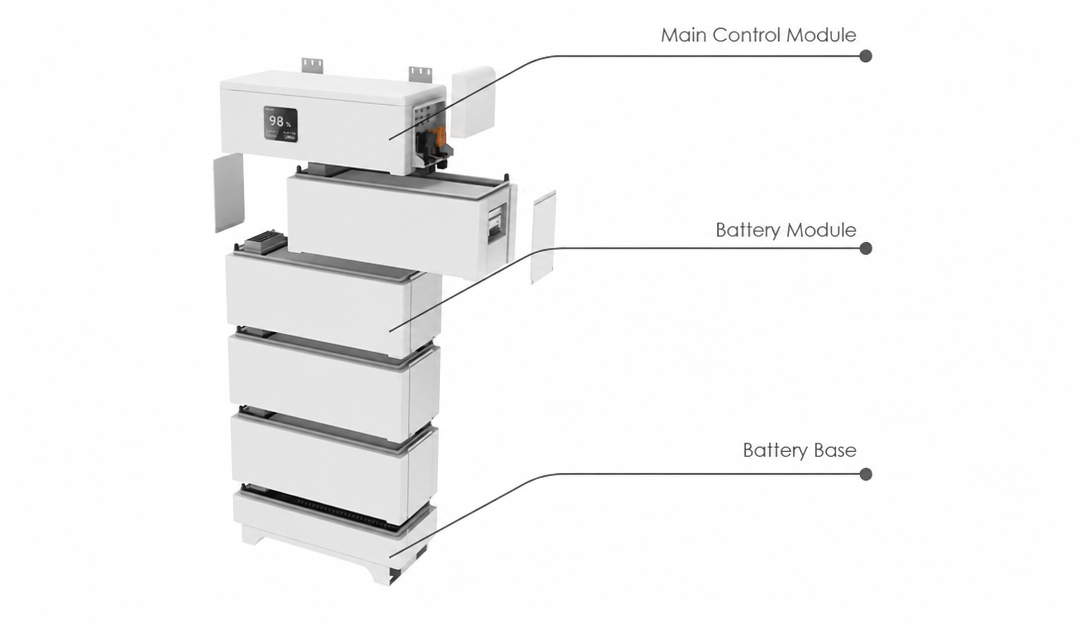
The first is modular growth within a single unit. Stackable systems use 5.12 kWh modules. Two modules give 10.24 kWh, and the stack scales to 30.72 kWh at six modules. You buy the enclosure once and add capacity as your needs change.
The second is parallel expansion across units. Our wall-mounted and floor-mounted ranges support up to 64 units running in parallel, communicating over CAN, RS485 or RS232. That covers growth from a single essential-load backup unit. It takes you up to a system carrying substantially larger loads, the whole point of battery expansion.
Battery expansion is cheaper if you plan for it on day one. Reserve wall or floor space for the additional enclosures. Size the cable runs and breaker for the final configuration, not the initial one. Also make sure the inverter you choose can handle the final charge and discharge current.
It is also worth confirming how addressing works, because battery expansion depends on it. Parallel systems use address settings to identify each unit. On the floor-mounted all-in-one cabinets, DIP switches plus an RJ45 Ethernet link handle this. Getting the addressing convention clear at the start saves time on the day you add a unit. It also keeps battery expansion simple.
For expandable battery storage, look for published parallel limits and published module sizes rather than marketing phrases about scalability. Compare the current ratings too. Adding capacity is straightforward. However, if the inverter cannot pass enough current, the extra kilowatt-hours will not translate into more usable power. That is a practical limit on expandable battery storage.
We list the current specifications on the stackable, wall-mounted and floor-mounted pages. We also collect the datasheets on our resources page. The requirements covering how expandable battery storage systems undergo testing and rating come from UL Solutions. Tell us your five-year plan and we will map the growth path for you — contact our engineers.
LiFePO4 home battery safety rests on three things: the chemistry, the protection electronics, and independent certification. All three need to be in place. It helps to know what each one actually does before you install a battery inside a home.

For battery safety, lithium iron phosphate is the thermally stable branch of the lithium family. Its olivine crystal structure holds oxygen more tightly than the layered oxide structure used in NMC cells. That structure resists the exothermic breakdown which drives thermal runaway. That is the main reason LiFePO4 is the default choice for residential storage rather than a niche option.
Our units use Grade A LiFePO4 cells from EVE, CATL or GOTION, configured 16S1P. Grade A means cells that meet the manufacturer’s specification for capacity and internal resistance. It excludes cells that failed screening and ended up resold.
The BMS is the layer that turns LiFePO4 safety into a safe product. Our units run a smart BMS with 18-layer protection. It covers over and under voltage, charge and discharge overcurrent, short circuit and low-temperature charge protection. It also covers high-temperature discharge protection, cell balancing, temperature monitoring and fault alarms.
Two of those deserve attention in a residential context. Low-temperature charge protection matters. Charging a lithium cell below freezing can plate metallic lithium on the anode and permanently damage it. High-temperature discharge protection and continuous temperature monitoring matter because heat is the common factor in almost every storage incident.
Battery safety also depends on independent testing, which separates a well-designed product from a verified one. The battery systems hold UL9540 and UL1973 certification. Our company documentation also lists UN38.3 and MSDS for transport, plus IEC62619 and CE.
You can read the published specifications on the wall-mounted and floor-mounted pages. You can also request certification documents through our resources page. Two bodies publish the standards themselves: UL Solutions and the International Electrotechnical Commission. Read more about our manufacturing and testing in about RUIDASIMAI.
The battery systems hold UL9540 and UL1973 certification. Our company documentation also lists UN38.3 and MSDS for transport, plus IEC62619 and CE. Because home battery certifications appear frequently in marketing without explanation, it is worth knowing what each one actually covers.

UL1973 is the standard for batteries used in stationary, vehicle auxiliary and light electric rail applications. It focuses on the cell and battery pack level. That means electrical safety, abuse tolerance and how the battery management system behaves under fault conditions. This page lists the certificates we hold; for how to verify a manufacturer’s marks before you order, see the nine certifications to verify.
UL9540 is the system-level standard for energy storage systems. It looks at the battery together with its power conversion and controls as an installed system. That is why it matters for permitting in many jurisdictions. A battery can hold UL1973 and still sit inside a system that needs UL9540.
IEC62619 is the international equivalent for industrial and stationary battery safety. It is another of the battery certifications we hold. CE marking indicates conformity with the applicable European directives. It is a declaration by the manufacturer, not a single test.
UN38.3 is the transport test series that lithium batteries must pass before shipping. It sits beside the battery certifications described above. The series covers altitude simulation, thermal cycling, vibration, shock, external short circuit, impact, overcharge and forced discharge. The MSDS describes the material composition and handling requirements. Both are logistics documents rather than product performance claims. You need both before a container can move.
For home battery certifications, ask for the certificate and the test report, not just the claim. Check that the certificate names the specific cell type and model you are buying. Certifications apply to a configuration, so a certificate for a different capacity or cell supplier does not automatically transfer.
We make documents for our units available on request through our resources page. The standards behind battery certifications come from UL Solutions and the International Electrotechnical Commission. Requirements for shipping lithium batteries by air come from IATA. You can also read about our production and testing in about RUIDASIMAI.
In a well-designed system, home battery overheating never gets a chance to become a visible problem. The battery management system watches cell temperature continuously and acts on it, The sequence of events during overheating is therefore a set of deliberate protections, not a single failure point.
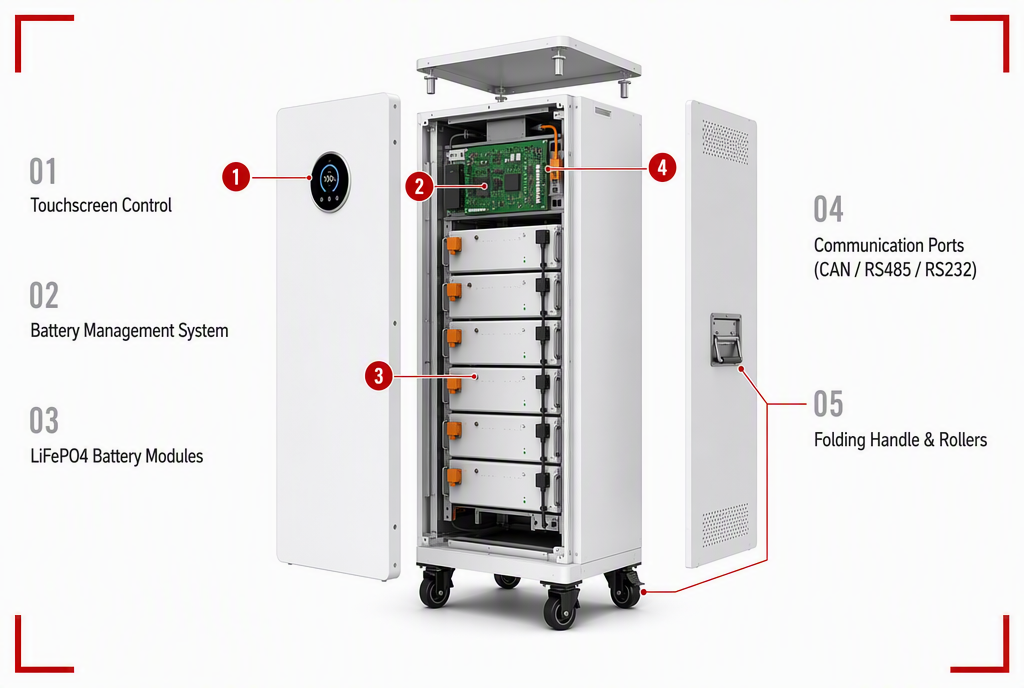
Home battery overheating protection starts with temperature monitoring, which runs continuously across the cells. If the pack approaches its upper limit, high-temperature discharge protection reduces or stops discharge. It does not let the cells keep working. On the charging side, low-temperature charge protection prevents charging below freezing, which would otherwise plate metallic lithium on the anode.
The protection set also includes over and under voltage limits, charge and discharge overcurrent limits and short circuit protection. It adds cell balancing, plus fire-safety monitoring with fault alarms. Because these layers operate independently, a single sensor fault does not remove the other protections. These protections are part of the broader safety case covered in our LiFePO4 home battery safety guide.
Our residential units use natural air cooling rather than forced ventilation. There are no fans to fail, no filters to block and no moving parts to service. That is a deliberate part of the battery thermal protection. An optional IP54 rating is available for enclosure protection. It keeps the electronics protected in a garage or utility room without needing a filtered airflow path.
The trade-off is that with no fan-based overheating protection, ambient temperature matters more. A naturally cooled cabinet relies on the air around it. It needs clearance, so do not box it in or place it next to another heat source.
Heat is the single biggest influence on how long a battery lasts. Battery thermal protection therefore matters more than peak ratings. The published cycle-life ratings for our units — 6,000 cycles or more for 5 kWh, and 8,000 cycles or more for 10 kWh and 16 kWh — come from testing at 25°C. Operating consistently above that temperature shortens service life even when the overheating protection never triggers.
That is why the practical advice is boring but effective: keep the cabinet out of direct sun, leave the specified clearance, and let the air move. Full technical specifications are on the floor-mounted and wall-mounted product pages. The safety standards behind this battery thermal protection come from UL Solutions. If your install site runs hot, talk to our engineers before you mount anything. For the cold-weather counterpart to this protection set, see our guide to home battery in winter.
If a cabinet runs hot, the cause is usually outside the pack. Work through the checks in this order before treating it as a battery fault, because the first three are things you can verify yourself.
Knowing how to size a home battery comes down to one thing. The loads you want to keep running decide it, not the floor area of the house. Sizing from square metres is the most common mistake we see. List the appliances you want alive during an outage. Add up their running watts, then multiply by the number of hours you need them. That gives you a kilowatt-hour figure you can match directly against a product range.
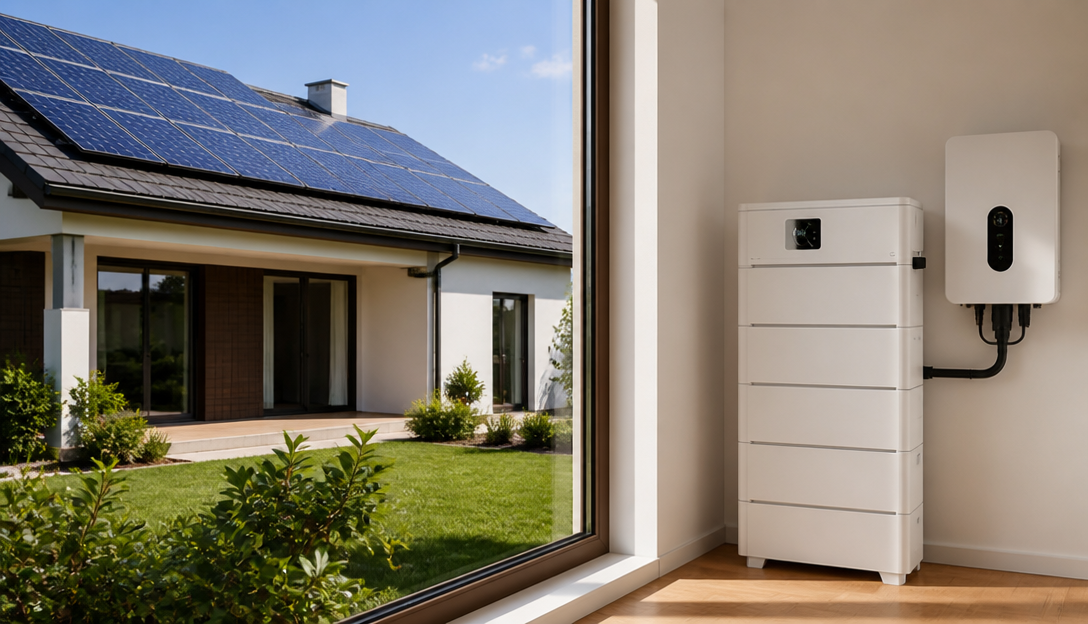
Start with the essentials: fridge, lighting, Wi-Fi router and phone charging. Write down the running watts of each. A well pump, sump pump, gas boiler or air conditioning unit will dominate the total. Decide early whether those are in scope, or whether they stay on the grid.
Multiply the total by the number of hours you want to cover. Then add a margin for conversion losses in the inverter. That result is your usable capacity — the figure home battery sizing turns on. Battery ranges come in usable kilowatt-hours, so you can compare your figure against the options without converting anything.
RUIDASIMAI covers the residential range in three formats, and home battery sizing usually starts with the smallest that fits. Wall-mounted units come in 5 kWh, 10 kWh and 16 kWh and suit homes where floor space is tight. Floor-mounted all-in-one cabinets use the same 5, 10 and 16 kWh capacities. Stackable systems start at 10.24 kWh with two 5.12 kWh modules and scale to 30.72 kWh with six.
Two practical checks before you commit. First, confirm the units support parallel expansion. Our units run up to 64 in parallel, so a small install today can grow later. That keeps home battery sizing flexible. Second, check your inverter’s continuous charge and discharge current against the battery. The inverter, not the battery, is usually the limiting component.
Load lists are easy to get wrong in two places: motor start-up currents and seasonal peaks. A pump that draws a few hundred watts when running can pull several times that for a moment at start-up. If your list includes motors, heating or a well pump, send it to us. Our engineers will confirm the home battery sizing rather than leaving it to a spreadsheet.
Battery sizing tables and datasheets for every model — useful for anyone sizing a battery bank — are on our resources page. Background reading on household energy use is available from the U.S. Department of Energy Energy Saver programme. When your load list is ready, contact us and we will size the system with you.
The published LiFePO4 battery cycle life for our units is 6,000 cycles or more for the 5 kWh model. The 10 kWh and 16 kWh models carry 8,000 cycles or more, measured at 25°C. Those are laboratory figures, so the useful question is what they mean in a real house. Unfamiliar terms are defined in our home battery glossary.
A battery cycle life rating starts from a simple definition: a cycle is one charge and one discharge. In a laboratory test the cells cycle under controlled conditions. The test runs until the remaining capacity falls to a defined percentage of the original, usually around 80%. The number published is the count at that point.
That definition matters because the test conditions stay fixed and real life does not. Temperature, depth of discharge and how you use the system all move the result, often substantially.
Temperature is the largest single factor affecting the cycle rating. The rating comes from testing at 25°C, and sustained operation above that shortens service life. This is one reason natural air cooling cabinets need clearance and must not sit boxed in.
Depth of discharge matters too. A battery you cycle shallowly, staying between roughly 30% and 80% state of charge, generally accumulates less stress per cycle. A battery that runs to empty and back to full every day accumulates more. Time-of-use shifting and solar self-consumption typically produce shallower, gentler cycles than daily full discharges.
Chemistry and cell grade set the ceiling. Our units use Grade A LiFePO4 cells from EVE, CATL or GOTION in a 16S1P configuration. That is why the 10 kWh and 16 kWh models can carry a higher published rating. The 5 kWh model carries a lower one.
Divide the rating by your expected cycles per year to turn battery cycle life into years of service. One full cycle a day is 365 cycles a year, Even the lower 6,000-cycle rating therefore covers a very long service window. Real household duty cycles are usually gentler than one full cycle a day. The warranty of more than 5 years with full-cycle service sits comfortably inside that envelope.
Specification tables for each capacity are on the wall-mounted and floor-mounted pages, with datasheets on our resources page. Data on storage deployment and grid-scale cycling comes from the U.S. Energy Information Administration.
A cycle rating only means something with the conditions attached. These are the conditions behind the figures on this page, taken from the same test basis the datasheet uses.
| Test item | Condition behind the rating |
|---|---|
| Test temperature | 25°C, controlled laboratory conditions |
| Cycle definition | One full charge and one full discharge |
| End-of-life threshold | Remaining capacity falls to around 80% of the original |
| 5 kWh model rating | 6,000 cycles or more |
| 10 kWh and 16 kWh models | 8,000 cycles or more |
| Cell grade and source | Grade A LiFePO4 cells from EVE, CATL or GOTION |
| Pack configuration | 16S1P |
| Real-use factors that move the result | Ambient temperature above the test point, and cycling to empty and back to full rather than staying between roughly 30% and 80% state of charge |
When you compare two suppliers, put this table in front of both and ask them to fill in their own figures. A rating quoted without a test temperature and an end-of-life threshold is not comparable.
The best home battery installation location is usually the one that is already conditioned. It should have clearance around the cabinet and sit close to the inverter and distribution board. Garage, basement and utility room all work in many homes, but each brings a different constraint.
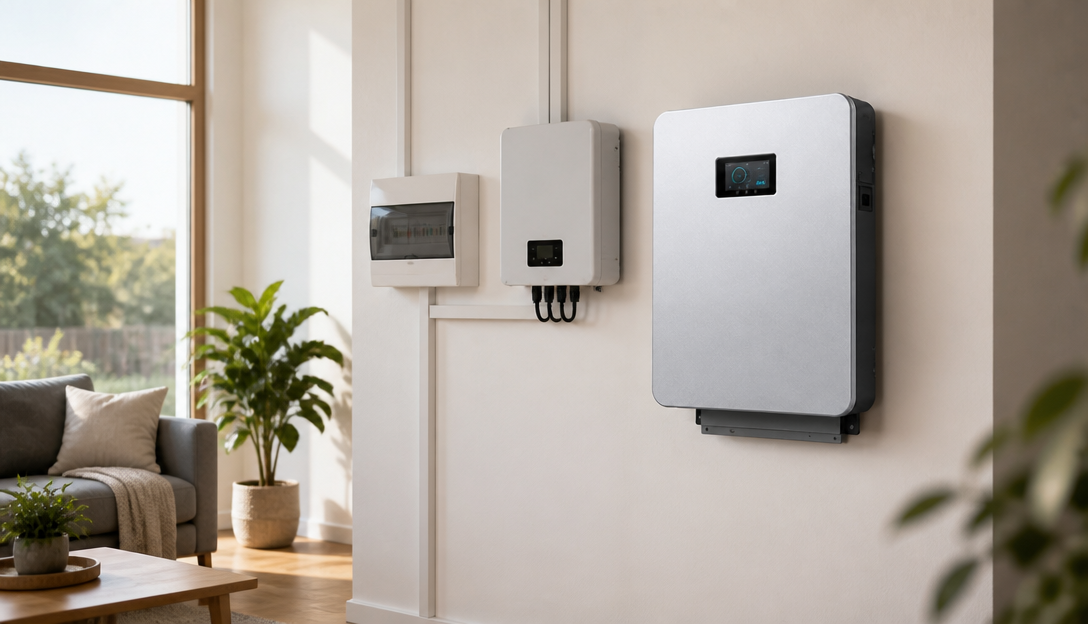
At any battery installation site, temperature stability comes first. Because our residential units use natural air cooling rather than forced ventilation, they rely on the air around the cabinet. A location that swings from freezing to very hot shortens service life. Our published cycle-life ratings come from testing at 25°C.
Moisture and dust come second. Enclosure protection is available as an optional IP54 rating, It covers splash and dust ingress. However, IP54 is not a licence to install in a wet room or in the path of direct spray. Cable routing matters too: shorter, protected runs between battery, inverter and board reduce losses and installation cost.
For most battery installation sites, utility rooms are often the easiest choice. They are indoors, already hold plant equipment, and typically have space to leave the specified clearance around the cabinet. That makes them a forgiving battery installation site. Wall-mounted units suit this setting well because they free the floor.
Basements are usually temperature-stable, That is ideal for life expectancy. You should still check for damp and for any flood risk. If the room can take on water, mount the unit above the expected level and keep connections high.
Garages divide opinion. An attached, insulated garage behaves much like a utility room. A detached or unheated garage sees wider temperature swings. In very cold climates that affects both performance and the ability to charge. That is rarely an ideal battery installation site. Floor-mounted all-in-one cabinets often suit garages because the whole system sits in one enclosure.
Local electrical rules, clearance requirements and any restrictions on where you may site storage vary by country and by property. For any battery installation site, send us your site conditions. Our engineers will confirm mounting and clearance for your installer. We collect the product drawings and datasheets on our resources page. We set out the format options on the wall-mounted, floor-mounted and stackable pages. Guidance on consumer battery installation comes from the UL Solutions.
The right battery size for overnight backup depends on two things. Your essential loads decide it, along with the number of hours you need to cover — not the size of the house. A typical overnight outage lasts eight to twelve hours. The calculation is then straightforward: add up the running watts of the appliances you refuse to lose, then multiply by the hours.
For overnight backup sizing, take the four loads almost everyone keeps on. Those are a fridge, LED lighting, a Wi-Fi router and phone charging. Add their running watts together, multiply by the hours you want covered, and add a margin for inverter conversion losses. That total looks small next to a whole-home figure. Essential-load backup is therefore the cheapest entry point into storage.
Now decide what else is in scope, because that is where overnight backup sizing usually goes wrong. A gas boiler circulator adds a modest load. A well pump, sump pump or air conditioning unit changes the answer completely. Those draw far more, and they often start with a surge.
For backup battery capacity, RUIDASIMAI publishes three residential sizes. They are 5 kWh, 10 kWh and 16 kWh, in both wall-mounted and floor-mounted all-in-one formats.
A 5 kWh unit is the smallest in the range. It covers a normal essential-load overnight outage, the usual starting point for overnight backup sizing. Move to 10 kWh or 16 kWh when the load also includes heating, a well pump or an air conditioning unit. Move up too when you want to carry the house through a longer outage without rationing. If you would rather buy capacity in steps, stackable systems let you start at 10.24 kWh and add 5.12 kWh modules up to 30.72 kWh.
One habit worth building before you settle on overnight backup sizing: measure your own consumption for a week before deciding. Meter data beats any rule of thumb, and it tells you whether your overnight baseload is closer to a fridge and a router or to a house with continuous heating.
Send us your appliance list and the hours you want covered. Our engineers will convert it into a backup battery capacity recommendation and confirm the inverter pairing at the same time. Datasheets for each model, useful for overnight backup sizing, are available on our resources page, and the U.S. Department of Energy. Ready to size a system? Get in touch.
