
Will the battery work with my existing inverter?
For most households the answer is yes. Our published compatibility figure is 99%, and the units pair with virtually all hybrid inverter brands. But home battery inverter compatibility is worth understanding properly. The pairing is a two-part question: physical and electrical fit, and communication.
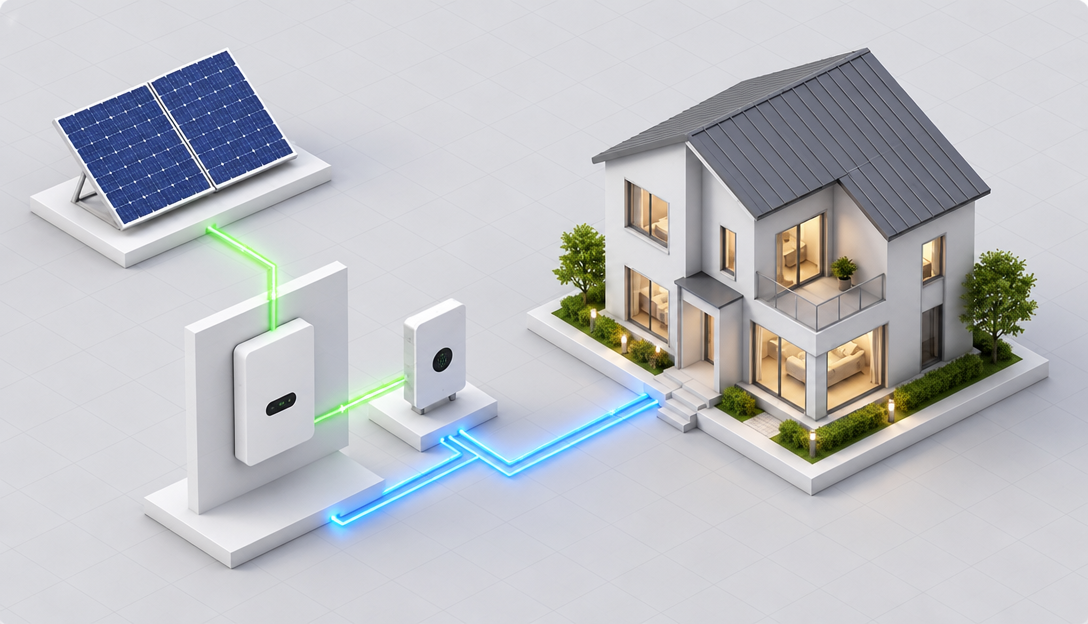
Part one: electrical fit
For inverter compatibility, nominal voltage and the number of series cells have to match. Check what your inverter expects from a lithium battery. Our units use a 16S1P LiFePO4 configuration, which is the common residential arrangement, so this is rarely the obstacle.
Continuous current is where mismatches actually appear. The 5 kWh unit takes 50 A continuous charge and delivers 100 A continuous discharge. The 10 kWh unit takes 100 A and delivers 200 A. The 16 kWh unit takes 150 A and delivers 300 A. If your inverter can pass more current than the battery can accept, the inverter becomes the limiting device. The available capacity then will not translate into the power you expected.
Part two: communication
Hybrid inverter pairing is completed over CAN, RS485 or RS232, depending on what your inverter accepts. Once you set the protocol and addressing, the battery reports state of charge, power and status to the inverter. That lets the inverter control charge and discharge properly.
In practice this is the step where installers spend their time, because each inverter brand implements its battery profile differently. Correct protocol settings and pin-out, ready before the visit, turn a compatibility claim into a working system.
How to confirm home battery inverter compatibility
Send us your inverter make and model and we will confirm the protocol settings. We publish the electrical specifications on the wall-mounted and floor-mounted product pages. Our datasheets on the resources page list the supported interfaces. Note that for expandable systems, inverter compatibility is separate from expandability. Our units support up to 64 in parallel. A confirmed pairing today can therefore grow into a larger bank later. General background on home energy systems comes from the U.S. Department of Energy.
Questions about anything on this page?
Send us your load list, your inverter model or a photo of the nameplate. Our engineers review the details and confirm what fits your site.
- Single-line diagram or load schedule
- Inverter make and model
- Photo of the nameplate or your existing battery
Prefer email? Write to admin@rdsmod.com