
What size battery do I need to keep essentials running overnight?
The right battery size for overnight backup depends on two things. Your essential loads decide it, along with the number of hours you need to cover — not the size of the house. A typical overnight outage lasts eight to twelve hours. The calculation is then straightforward: add up the running watts of the appliances you refuse to lose, then multiply by the hours.
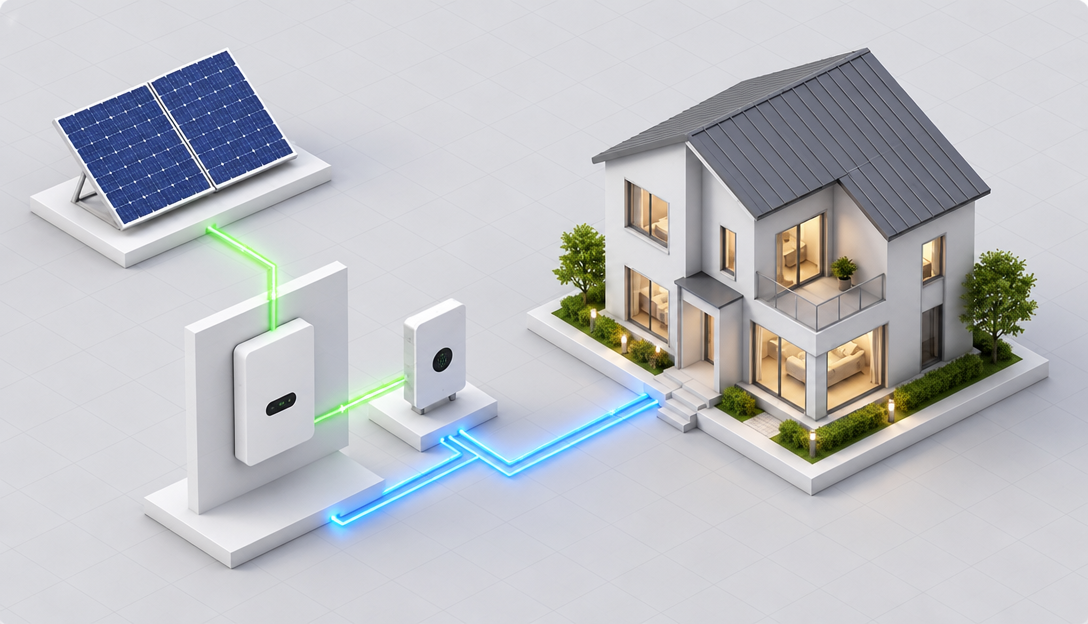
A simple way to estimate the battery size for overnight backup
For overnight backup sizing, take the four loads almost everyone keeps on. Those are a fridge, LED lighting, a Wi-Fi router and phone charging. Add their running watts together, multiply by the hours you want covered, and add a margin for inverter conversion losses. That total looks small next to a whole-home figure. Essential-load backup is therefore the cheapest entry point into storage.
Now decide what else is in scope, because that is where overnight backup sizing usually goes wrong. A gas boiler circulator adds a modest load. A well pump, sump pump or air conditioning unit changes the answer completely. Those draw far more, and they often start with a surge.
Which capacity fits which overnight load
For backup battery capacity, RUIDASIMAI publishes three residential sizes. They are 5 kWh, 10 kWh and 16 kWh, in both wall-mounted and floor-mounted all-in-one formats.
A 5 kWh unit is the smallest in the range. It covers a normal essential-load overnight outage, the usual starting point for overnight backup sizing. Move to 10 kWh or 16 kWh when the load also includes heating, a well pump or an air conditioning unit. Move up too when you want to carry the house through a longer outage without rationing. If you would rather buy capacity in steps, stackable systems let you start at 10.24 kWh and add 5.12 kWh modules up to 30.72 kWh.
One habit worth building before you settle on overnight backup sizing: measure your own consumption for a week before deciding. Meter data beats any rule of thumb, and it tells you whether your overnight baseload is closer to a fridge and a router or to a house with continuous heating.
Getting the number right the first time
Send us your appliance list and the hours you want covered. Our engineers will convert it into a backup battery capacity recommendation and confirm the inverter pairing at the same time. Datasheets for each model, useful for overnight backup sizing, are available on our resources page, and the U.S. Department of Energy. Ready to size a system? Get in touch.
Questions about anything on this page?
Send us your load list, your inverter model or a photo of the nameplate. Our engineers review the details and confirm what fits your site.
- Single-line diagram or load schedule
- Inverter make and model
- Photo of the nameplate or your existing battery
Prefer email? Write to admin@rdsmod.com