
How many cycles does a LiFePO4 home battery last?
The published LiFePO4 battery cycle life for our units is 6,000 cycles or more for the 5 kWh model. The 10 kWh and 16 kWh models carry 8,000 cycles or more, measured at 25°C. Those are laboratory figures, so the useful question is what they mean in a real house. Unfamiliar terms are defined in our home battery glossary.
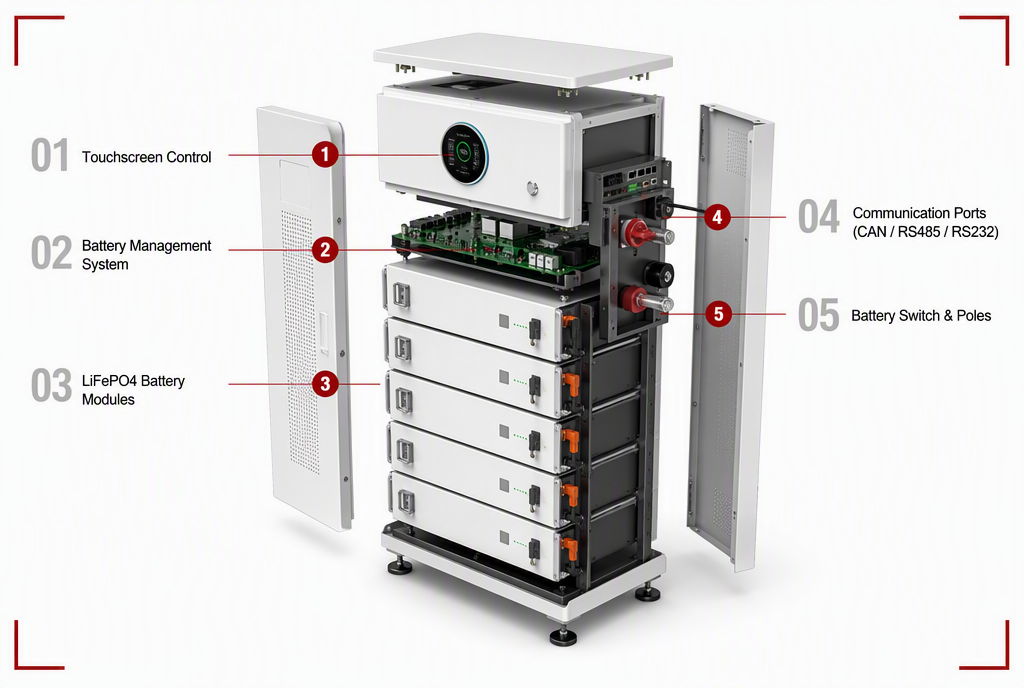
What a Cycle Rating Actually Measures
A battery cycle life rating starts from a simple definition: a cycle is one charge and one discharge. In a laboratory test the cells cycle under controlled conditions. The test runs until the remaining capacity falls to a defined percentage of the original, usually around 80%. The number published is the count at that point.
That definition matters because the test conditions stay fixed and real life does not. Temperature, depth of discharge and how you use the system all move the result, often substantially.
What Changes LiFePO4 Battery Cycle Life in Practice
Temperature is the largest single factor affecting the cycle rating. The rating comes from testing at 25°C, and sustained operation above that shortens service life. This is one reason natural air cooling cabinets need clearance and must not sit boxed in.
Depth of discharge matters too. A battery you cycle shallowly, staying between roughly 30% and 80% state of charge, generally accumulates less stress per cycle. A battery that runs to empty and back to full every day accumulates more. Time-of-use shifting and solar self-consumption typically produce shallower, gentler cycles than daily full discharges.
Chemistry and cell grade set the ceiling. Our units use Grade A LiFePO4 cells from EVE, CATL or GOTION in a 16S1P configuration. That is why the 10 kWh and 16 kWh models can carry a higher published rating. The 5 kWh model carries a lower one.
Converting Cycles into Years
Divide the rating by your expected cycles per year to turn battery cycle life into years of service. One full cycle a day is 365 cycles a year, Even the lower 6,000-cycle rating therefore covers a very long service window. Real household duty cycles are usually gentler than one full cycle a day. The warranty of more than 5 years with full-cycle service sits comfortably inside that envelope.
Specification tables for each capacity are on the wall-mounted and floor-mounted pages, with datasheets on our resources page. Data on storage deployment and grid-scale cycling comes from the U.S. Energy Information Administration.
Test Conditions Behind the Rating
A cycle rating only means something with the conditions attached. These are the conditions behind the figures on this page, taken from the same test basis the datasheet uses.
| Test item | Condition behind the rating |
|---|---|
| Test temperature | 25°C, controlled laboratory conditions |
| Cycle definition | One full charge and one full discharge |
| End-of-life threshold | Remaining capacity falls to around 80% of the original |
| 5 kWh model rating | 6,000 cycles or more |
| 10 kWh and 16 kWh models | 8,000 cycles or more |
| Cell grade and source | Grade A LiFePO4 cells from EVE, CATL or GOTION |
| Pack configuration | 16S1P |
| Real-use factors that move the result | Ambient temperature above the test point, and cycling to empty and back to full rather than staying between roughly 30% and 80% state of charge |
When you compare two suppliers, put this table in front of both and ask them to fill in their own figures. A rating quoted without a test temperature and an end-of-life threshold is not comparable.