
Choosing a home battery comes down to three decisions: how much energy you need, which form factor fits your installation position, and whether the system can grow with you. This home battery comparison sets out the trade-offs for each, drawing on the specifications RUIDASIMAI publishes across the range. For the form-factor explanation itself, read our guide to wall-mounted, floor-mounted and stackable batteries; this page stays a side-by-side specification comparison of the models on this site.
Residential storage now underpins most new solar installations (see home energy storage for the broader picture), and the battery choice follows the home, not the other way around.
Decision 1: Capacity in Any Home Battery Comparison
A meaningful home battery comparison starts with capacity: size it against your evening and overnight consumption, not against your annual bill. In practice, take your average daily household consumption, estimate the share that falls outside solar hours, and add headroom for winter.
As a starting point:
- Around 5 kWh — apartments and small homes with modest evening demand, or a first step into storage where the priority is shifting a few high-rate hours rather than covering the whole night.
- Around 10 kWh — a typical three-bedroom home shifting most evening consumption and covering short outages. The most common single-unit size.
- Around 16 kWh — larger homes with heat pumps or electric water heating, or households that want to ride through a full night plus a partial outage day.
If your target goes beyond what a single unit provides, a stackable system lets you build capacity from identical modules rather than move to a different product line. The RUIDASIMAI stackable range spans 10.24 kWh to 30.72 kWh in 5.12 kWh module steps, which is two to six modules.
Do not size on capacity alone
Two systems quoting the same kWh figure are not equivalent. Check the depth of discharge at which that capacity stays usable, the power rating that sets how much load the battery carries at once, and whether the inverter can draw full continuous power rather than a reduced figure.
Decision 2: Stackable, Wall-Mounted or Floor-Mounted
The home battery comparison gets more personal at this step, because form factor follows the installation position, not performance.
Stackable
Identical modules stack vertically, so capacity grows with module count. The advantages are expandability after installation and a footprint that stays narrow as capacity increases. The design suits a utility room or garage where floor space is limited but height is available.
Choose stackable when you expect your demand to grow — a future EV, a heat pump, or a household that may add a home office or extension.
Wall-mounted
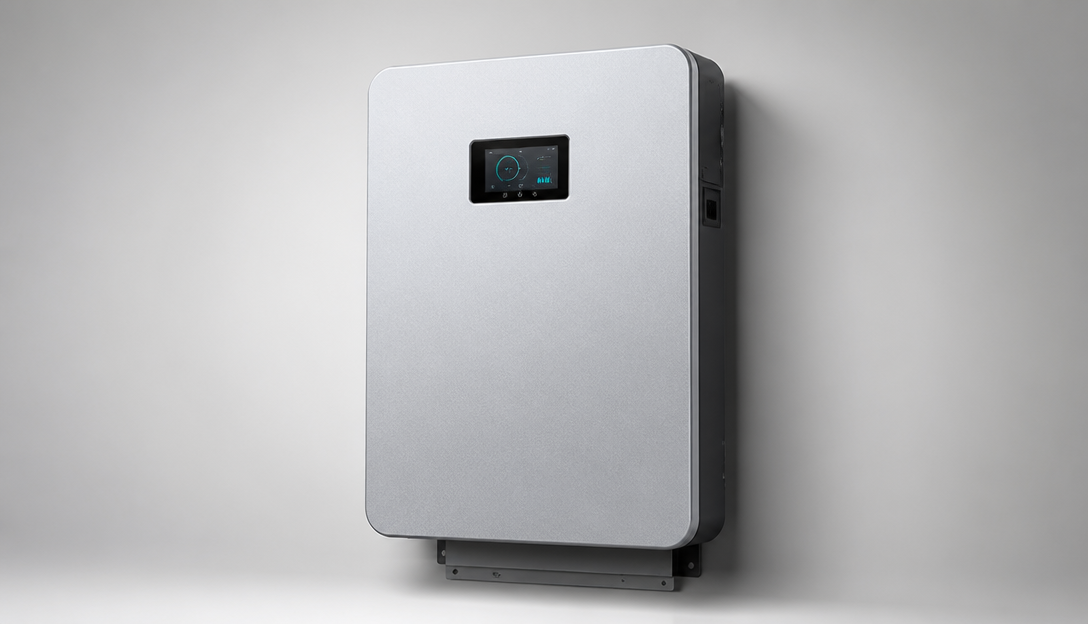
A slim enclosure fixed to a wall keeps the floor completely clear and lifts the battery above any standing water risk. Typically, garages and utility rooms with contested floor space call for this format, as long as the wall is structurally suitable for the unit’s weight.
Choose wall-mounted when floor area is the binding constraint and capacity needs are moderate.
Floor-mounted
A freestanding enclosure resting on the floor carries larger and heavier modules than a wall fixing can. As a result, it is the option for the highest single-unit capacities, and it sidesteps any wall-loading question. It is also the practical choice where the available walls are not suitable for a heavy fix.
Choose floor-mounted when you need maximum capacity per unit or when the installation wall is unsuitable.
Decision 3: Checks to Run in Any Home Battery Comparison
Inverter compatibility
The battery and inverter must agree on voltage windows and communication protocol. In a closed loop, the battery reports its state to the inverter, and that feedback lets the inverter manage charge and discharge more accurately than voltage alone would. Inverter compatibility is also the least visible line in a home battery comparison. RUIDASIMAI home batteries use CAN, RS485 and RS232, and they cover the great majority of hybrid inverters on the market.
Expansion path
In any home battery comparison, expansion is the line most buyers skip — adding capacity later costs less than replacing a system. Confirm how many units you can parallel, and make sure the inverter supports the higher total. The RUIDASIMAI range supports parallel expansion up to 64 units.
Installation environment
An IP54 rating allows installation in a garage or a sheltered outdoor position, rather than restricting you to a dry indoor room. If your only viable position is a garage or a semi-exposed wall, look twice at ingress protection. It stops being an optional extra.
Certifications for your market
Safety certification is market-specific. RUIDASIMAI specifies North American systems to UL 9540 and UL 1973, and IEC 62619 covers the international stationary case. Every destination also requires the transport documentation — UN 38.3 and the material safety data sheet. Confirm the certification set matches the country of installation before you order.
Cycle life and warranty
Cycle life depends on the temperature and depth of discharge at which manufacturers measure it, so you cannot compare figures from different conditions directly. RUIDASIMAI rates its home batteries at 6,000 cycles or better at 25°C, higher-rated models reach 8,000 cycles, and every unit carries a warranty of more than five years.
Cell grade
Grade A cells from established manufacturers behave more predictably over a long service life than lower grades do, particularly in cell-to-cell consistency. RUIDASIMAI systems use Grade A prismatic cells in a 16S1P configuration.
Home Battery Comparison Summary
The table below compresses the three form factors into five rows.
| Consideration | Stackable | Wall-mounted | Floor-mounted |
|---|---|---|---|
| Best for | Growing demand, expandable capacity | Limited floor space | Maximum capacity per unit |
| Expansion | Add modules to the stack | Add parallel units | Add parallel units |
| Floor footprint | Small, narrow | None | Largest |
| Installation constraint | Height available | Structurally suitable wall | Level floor, no wall loading |
| Capacity flexibility | Highest | Moderate | High |
Installation position also affects safety and code compliance — see where a home battery can be installed. If you are still deciding on capacity, start with sizing a home battery or the capacity options explained.
Custom Configuration
If none of the standard options in this home battery comparison fits the load profile, the available space or the brand requirements, you can specify capacity, voltage, enclosure and branding to order. See customising a home battery for what you can change and what the underlying cell and safety design fix.