
What happens if the battery overheats?
In a well-designed system, home battery overheating never gets a chance to become a visible problem. The battery management system watches cell temperature continuously and acts on it, The sequence of events during overheating is therefore a set of deliberate protections, not a single failure point.
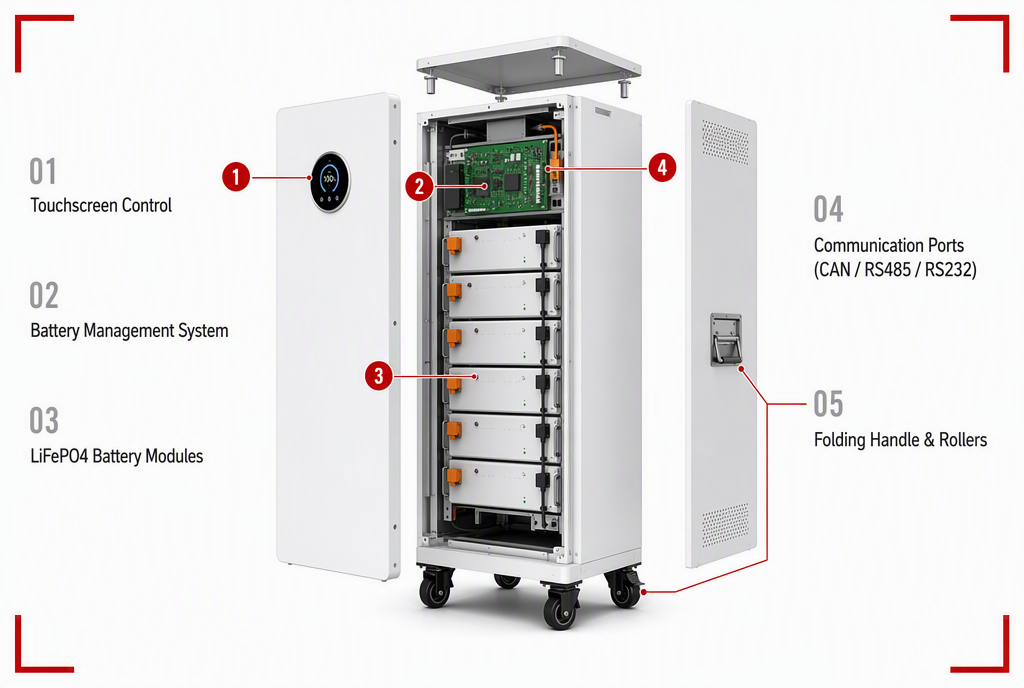
What the BMS does during home battery overheating
Home battery overheating protection starts with temperature monitoring, which runs continuously across the cells. If the pack approaches its upper limit, high-temperature discharge protection reduces or stops discharge. It does not let the cells keep working. On the charging side, low-temperature charge protection prevents charging below freezing, which would otherwise plate metallic lithium on the anode.
The protection set also includes over and under voltage limits, charge and discharge overcurrent limits and short circuit protection. It adds cell balancing, plus fire-safety monitoring with fault alarms. Because these layers operate independently, a single sensor fault does not remove the other protections.
Why these units use natural air cooling
Our residential units use natural air cooling rather than forced ventilation. There are no fans to fail, no filters to block and no moving parts to service. That is a deliberate part of the battery thermal protection. An optional IP54 rating is available for enclosure protection. It keeps the electronics protected in a garage or utility room without needing a filtered airflow path.
The trade-off is that with no fan-based overheating protection, ambient temperature matters more. A naturally cooled cabinet relies on the air around it. It needs clearance, so do not box it in or place it next to another heat source.
Temperature and cycle life
Heat is the single biggest influence on how long a battery lasts. Battery thermal protection therefore matters more than peak ratings. The published cycle-life ratings for our units — 6,000 cycles or more for 5 kWh, and 8,000 cycles or more for 10 kWh and 16 kWh — come from testing at 25°C. Operating consistently above that temperature shortens service life even when the overheating protection never triggers.
That is why the practical advice is boring but effective: keep the cabinet out of direct sun, leave the specified clearance, and let the air move. Full technical specifications are on the floor-mounted and wall-mounted product pages. The safety standards behind this battery thermal protection come from UL Solutions. If your install site runs hot, talk to our engineers before you mount anything.
Questions about anything on this page?
Send us your load list, your inverter model or a photo of the nameplate. Our engineers review the details and confirm what fits your site.
- Single-line diagram or load schedule
- Inverter make and model
- Photo of the nameplate or your existing battery
Prefer email? Write to admin@rdsmod.com