Retrofitting storage to an existing solar array raises one question before any other: do you keep the inverter you already own? The answer decides between an AC-coupled battery and a DC-coupled one, and it shapes cost, efficiency and how much equipment comes off the wall.
Both arrangements store the same kilowatt-hours. They differ in where the power conversion happens. AC coupling adds a conversion step, and DC coupling removes one. That single detail drives everything else in the comparison.
What an AC-Coupled Battery Actually Does
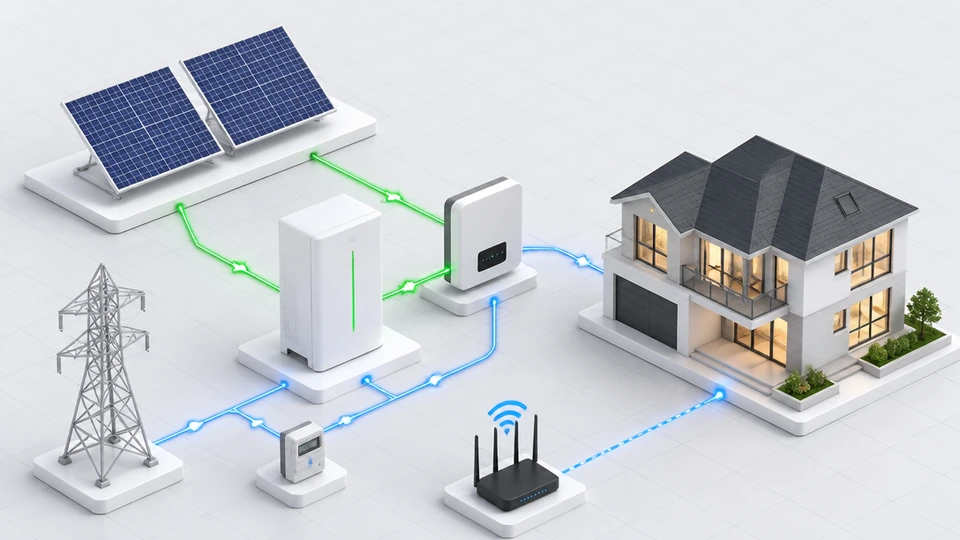
An AC-coupled battery connects on the AC side of your system, downstream of the existing solar inverter. The inverter keeps its original job. The battery charges and discharges through its own built-in converter.
This is the retrofit-friendly arrangement. You add one enclosure, keep the inverter you already paid for, and leave the solar array untouched. AC coupling therefore suits a site whose existing inverter still has years of service left.
How the Two Topologies Differ
A DC-coupled system links the panels and the battery on the same DC bus, sharing one hybrid inverter. The panels then charge the battery directly, without converting to AC first and back again.
DC coupling saves one conversion step in each direction. In practice, a little more of your solar generation ends up stored. That matters most on short winter days, when generation is thin and every kilowatt-hour counts.
Where the Two Designs Diverge
| Question | AC coupling | DC coupling |
|---|---|---|
| Existing inverter | Kept in place | Usually replaced |
| Conversion steps for stored energy | Two | One |
| Installation scope | One new enclosure and a supply connection | New hybrid inverter plus battery |
| Wall space | Two separate units | One combined unit |
| Typical fit | Retrofit onto working solar | New build or full replacement |
Read that table top to bottom and the pattern is clear. An AC-coupled battery wins on retrofit simplicity. A DC-coupled battery wins on conversion losses, and DC coupling also frees up wall space.
When DC Coupling Is the Better Answer
New-build systems and full replacements often favour DC coupling. If you are buying a hybrid inverter anyway, the shared DC bus costs nothing extra. It also suits sites with limited wall space, because one combined unit replaces two.
Battery-first designs follow the same logic. When the battery is the main investment and the array comes later, DC coupling leaves the door open for panels that have not been bought yet.
How to Choose for Your Own Site
Check three things before you decide. First, look at the age and condition of your existing inverter, because AC coupling only pays off while that unit still works. Second, check whether your market pays you for stored energy, since that changes the value of the extra efficiency. Third, decide whether you plan to add panels later, because DC coupling with a hybrid inverter gives you that room.
If you expect to expand, our units support parallel expansion up to 64 in parallel. The stackable range also grows in 5.12 kWh steps from 10.24 kWh to 30.72 kWh. Our selection guide sets out the capacity side of that decision.
Retrofit viability of AC coupling also depends on inverter compatibility. Our guide to inverter compatibility covers the protocol and current limits that decide whether a pairing works.
For the underlying terms, the home battery glossary explains round-trip efficiency, hybrid inverters and MPPT tracking.
Safety requirements for AC coupling and for DC coupling come from two sources. UL sets out UL 9540 and UL 1973, and the International Electrotechnical Commission publishes IEC 62619.
Send us your existing inverter model and your array size. We will confirm which arrangement fits, and whether an AC-coupled battery is the simpler route for your site.
Frequently Asked Questions
What is the main difference between AC-coupled and DC-coupled batteries?
AC coupling connects the battery on the AC side, downstream of the existing solar inverter, which keeps that inverter in place and adds one conversion step. DC coupling links the panels and battery on the same DC bus through one shared hybrid inverter, saving a conversion step in each direction.
Which option is better for retrofitting an existing solar system?
AC coupling is generally the retrofit-friendly option because it keeps the existing solar inverter and adds a separate battery enclosure, as long as that inverter still has years of useful service left.
Which option is more efficient?
DC coupling is generally more efficient because it removes one conversion step for stored energy, which can capture a little more of the available solar generation, particularly on short winter days when generation is limited.
When does DC coupling make more sense than AC coupling?
DC coupling tends to fit new-build systems, full inverter replacements, battery-first designs where panels are added later, and sites with limited wall space, since one combined hybrid inverter replaces two separate units.
What should I check before choosing between the two?
Check the age and condition of your existing inverter, whether your market pays for stored energy (which changes the value of the extra DC-coupled efficiency), and whether you plan to add panels later, since a hybrid inverter leaves that option open.
Engineering support
Retrofit questions about AC vs DC coupling?
Upload your inverter nameplate and current system layout. Our engineers confirm the safer coupling route for your install.
- Inverter make, model and serial (nameplate photo)
- Array size and roof or ground layout
- Breaker sizes and panel space, if known
Prefer email? Write to admin@rdsmod.com