Home battery transfer time determines how quickly a residential energy storage system moves a home from grid power to battery-backed power after an outage. A 20 ms transfer can feel nearly instantaneous, while a 10 s transfer may cause lights, routers, computers, or other sensitive loads to restart.
However, transfer time is not simply a battery specification. It depends on the inverter, transfer switch or backup gateway, control logic, grid detection, operating mode, and the loads being protected. For buyers comparing home battery systems, the right question is therefore not only “How fast is the battery?” but “How fast can the complete system detect the outage, isolate from the grid, and establish stable backup power?”
What Is Home Battery Transfer Time?
Home battery transfer time is the elapsed time between loss of utility power and the point when the backup system supplies usable power to the protected loads.
In a typical residential battery system, the sequence looks like this:
Grid failure → outage detection → grid isolation → inverter transition → battery discharge → backup power to loads
The battery cells themselves are not normally responsible for the entire transfer interval. Instead, the inverter and switching equipment determine much of the transition behavior.
This distinction matters when comparing specifications. A battery pack may have excellent electrical response, but the overall system can still take seconds to transfer if an external automatic transfer switch or backup controller uses a slower sequence.
The U.S. Department of Energy describes residential solar-plus-storage systems as detecting grid loss and switching into an islanded operating mode during an outage.
Therefore, system-level transfer time is the specification that homeowners, installers, and OEM buyers should verify.

20 ms vs 10 s: Why the Difference Matters
A 20 ms transfer and a 10 s transfer produce very different user experiences.
At 20 ms, the interruption is only 0.02 seconds. Many household loads can continue operating without an obvious restart, provided the inverter output remains within the required electrical limits.
At 10 seconds, the interruption is long enough for many electronic devices to shut down. Wi-Fi routers can reboot. Desktop computers can lose power. Smart home controllers may restart. Some appliances may require manual recovery.
The table below illustrates the practical difference:
| Transfer time | Typical user experience | Suitable application |
|---|---|---|
| ~20 ms | Near-seamless for many loads | Sensitive electronics, networking, home office |
| 50–100 ms | Short interruption may be noticeable | General residential backup |
| 1–5 s | Clear power interruption | Basic backup loads |
| ~10 s | Devices may shut down and restart | Loads that tolerate interruption |
These ranges should not be treated as universal industry classes. Actual performance depends on the system architecture and the equipment connected to it.
NREL also distinguishes storage-system response time from other system functions. In its Storage Futures Study, response time is defined as the time for a storage system to go from rest to rated output, with battery systems typically around one second in that particular grid-storage context.
That figure should not be confused with residential transfer time. A home battery can respond electrically very quickly while the complete backup system still requires additional time to detect and isolate a grid outage.
What Controls Home Battery Transfer Time?
Several components can influence home battery transfer time.
1. Grid Detection
The system must first recognize that utility power has failed or moved outside its permitted operating range.
Detection logic must distinguish a real outage from normal voltage or frequency variation. A faster detection strategy can reduce transfer time, but it must also avoid unnecessary switching.
2. Transfer Switch or Backup Gateway
The transfer device separates the home from the utility grid before the battery supplies the house in island mode.
This component can have a major effect on the final transfer time. A system advertised as “seamless” should therefore be evaluated as a complete system rather than by looking only at the battery module.
3. Inverter Transition
The inverter must establish an independent AC output after the grid disappears.
This involves controlling voltage, frequency, phase, and power flow. The inverter also has to coordinate with the battery management system and other system controls.
4. Battery Management System
The BMS determines whether the battery is available to discharge and whether operating conditions are safe.
State of charge, temperature, current limits, protection conditions, and communication status can all affect whether the battery can immediately deliver power.
5. Load Characteristics
Not every appliance reacts to an interruption in the same way.
A simple resistive load may tolerate a brief interruption. A motor-driven appliance can behave differently. Sensitive electronics may depend on the quality and continuity of the inverter output.
For this reason, specifying a transfer time without specifying the load conditions gives an incomplete picture.
Why a “Seamless” Claim Is Not Enough
Home battery manufacturers often use terms such as “seamless backup” or “instant backup.”
These terms are useful for marketing, but they do not replace a measured transfer-time specification.
A buyer should ask:
- What is the measured transfer time?
- Where was it measured?
- Is the number for the battery, inverter, or complete system?
- Does it apply to the whole home or only backed-up circuits?
- What load was connected during the test?
- Was the system operating with solar PV?
- What was the battery state of charge?
- How was the result measured?
A current comparison of residential battery specifications shows why this distinction matters: some manufacturers publish numerical transfer times, while others use “seamless” without publishing a number.
For procurement, a numerical specification with defined test conditions is more useful than an unqualified adjective.
How a 20 ms Home Battery System Works
A system designed around approximately 20 ms transfer time needs more than a large battery pack.
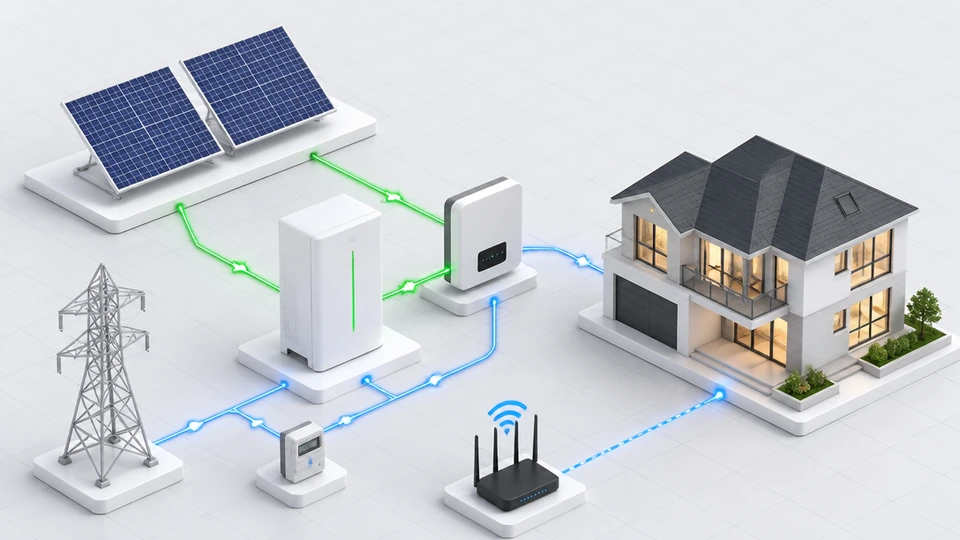
The architecture generally requires coordinated operation between the battery, inverter, control system, and switching equipment.
Before an outage, the inverter is already connected to the home’s electrical system and monitors grid conditions. When the grid fails, the system detects the abnormal condition, isolates the home from the utility, and changes to backup operation.
The battery then supplies DC energy to the inverter, which maintains the required AC output.
The critical engineering goal is to minimize the gap between these states.
This is why a fast-transfer residential battery is better understood as a power electronics and control-system solution, not simply a high-capacity battery.
For OEM buyers, this distinction is important when comparing suppliers. A battery manufacturer may supply the battery pack while another company supplies the inverter and transfer equipment. The final transfer performance can therefore depend on integration between multiple suppliers.
When 10 Seconds Can Still Be Acceptable
A 10-second transfer is not automatically a design failure.
Some residential applications only require backup power after a short interruption. If the protected load can tolerate several seconds without damage or inconvenient recovery, a slower transfer architecture may be sufficient.
For example, a homeowner may prioritize:
- lower system cost;
- longer backup duration;
- larger usable capacity;
- simpler installation;
- support for heavy loads.
In these cases, transfer time is only one part of the specification.
NREL’s resilience research similarly emphasizes that backup-system selection depends on factors such as critical loads, anticipated outage duration, and the value assigned to resilience.
The correct specification therefore starts with the loads that must remain powered.
Which Loads Need Fast Transfer?
Not every appliance requires a 20 ms transition.
Sensitive electronics
Computers, networking equipment, security systems, smart-home controllers, and communication equipment can be more sensitive to interruptions.
For these loads, a short transfer time can reduce unwanted shutdowns and restarts.
Refrigerators and freezers
Refrigerators normally tolerate short interruptions, although compressor loads can introduce additional requirements during restart.
The important specifications include both transfer time and inverter surge capability.
Pumps and motors
Well pumps, HVAC equipment, sump pumps, and other motors can require significant starting power.
A fast transfer alone does not guarantee successful operation. The inverter must also provide sufficient peak power and manage the motor’s starting characteristics.
Whole-home loads
A whole-home backup system introduces another consideration: the system must manage a wide range of loads simultaneously.
Therefore, buyers should evaluate transfer time together with continuous output power, peak power, phase configuration, and load-management functions.
How Should Buyers Specify Transfer Time?
For an RFQ or technical specification, avoid writing only:
“Seamless backup required.”
A stronger requirement defines the measurement.
For example:
Required transfer time: ≤20 ms from verified utility-loss event to stable backup output at the protected load, under defined nominal-voltage, frequency, SOC, and load conditions.
The exact acceptance criteria should be adapted to the product architecture and applicable certification requirements.
A useful RFQ should also request:
- Rated continuous output power.
- Peak or surge output power.
- Transfer-time specification.
- Test method and measurement point.
- Minimum battery SOC for backup operation.
- Supported voltage and frequency.
- Whole-home or critical-load configuration.
- Inverter and transfer-switch model.
- Applicable certifications.
- Installation limitations and operating conditions.
This approach makes supplier comparisons much more objective.
Transfer Time vs Battery Response Time
These two specifications are frequently confused.
Battery response time describes how quickly the battery system can change its power output.
Transfer time describes how quickly the home moves from grid supply to backup supply.
A battery can have a fast electrical response while the home’s actual transfer takes longer because the system still has to detect the outage and switch operating modes.
NREL’s battery-storage modeling resources treat the battery, power converter, battery voltage, losses, and dispatch behavior as separate system parameters.
For this reason, an OEM should request system-level test data rather than assuming that battery-cell or battery-pack performance determines the final transfer time.
What Certifications Matter?
Transfer speed is only one part of residential energy-storage design.
For the U.S. market, buyers also need to consider the applicable safety and installation requirements for the complete energy storage system.
UL Solutions explains that UL 9540 covers energy storage systems and equipment, including charging and discharging, protection, control, communication, and grid interaction. It also references standards such as UL 1973 and UL 1741.
UL Solutions also notes that residential ESS requirements continue to evolve, including testing considerations under UL 9540A and UL 9540B.
Therefore, a supplier should not present “20 ms transfer” as a substitute for system certification. Transfer performance and safety certification address different engineering requirements.
How Manufacturers Can Improve Transfer Performance
For a home battery OEM, improving transfer time usually requires system-level optimization.
The main engineering areas include:
- faster and reliable grid-status detection;
- optimized transfer-switch control;
- inverter pre-synchronization;
- stable backup-mode transition;
- low-latency communication between controls;
- appropriate BMS response;
- defined standby operating conditions;
- validation under realistic residential loads.
Testing should also include different states of charge, temperatures, load levels, and operating modes.
A single successful demonstration does not fully characterize system performance.
The goal is repeatable transfer performance, not simply one fast measurement.
Home Battery Transfer Time: What Should You Choose?
There is no universal transfer time that fits every home.
If the objective is near-uninterrupted operation for sensitive household electronics, a system around 20 ms can be an important design target.
If the protected loads can tolerate a short outage, a system with a transfer time measured in seconds may still satisfy the application’s requirements.
The key is to connect the transfer-time requirement to the actual load.
For homeowners, the practical question is: Which devices must stay on without restarting?
Installers face a different bar: does the complete backup architecture meet the required load and electrical behavior?
OEM buyers add a data requirement: can the supplier provide measured system-level transfer data under defined conditions?
That last question is especially important when comparing battery manufacturers. The battery pack, inverter, transfer equipment, BMS, and control software work together. A published battery capacity figure does not tell you how quickly the house will regain backup power.
Final Buyer Checklist
Before approving a residential battery system, verify these five points:
1. Transfer time: Require a numerical value rather than only “seamless.”
2. Measurement point: Confirm whether the specification is measured at the inverter output, transfer device, or protected load.
3. Test conditions: Request voltage, frequency, load, SOC, temperature, and operating-mode conditions.
4. Load capability: Check continuous and surge output as well as transfer time.
5. Certification: Verify the applicable system-level certifications and installation requirements.
Fast backup is a system-design result. A 20 ms target can provide a very different user experience from a 10 s transfer, but the number only has value when the measurement method and complete system architecture are clear.
For residential energy-storage OEM projects, RUIDASIMAI can support battery-system development around defined power, capacity, communication, enclosure, and backup-performance requirements. Share your electrical specifications and target application for engineering review before finalizing the battery architecture.
Frequently Asked Questions
What is home battery transfer time?
Home battery transfer time is the elapsed time between the loss of utility power and the point when the backup system supplies usable power to the protected loads. It depends on grid detection, the transfer switch or backup gateway, inverter transition, and the battery management system, not on the battery cells alone.
Why does a 20 ms transfer feel different from a 10 s transfer?
At 20 ms, the interruption is about 0.02 seconds, so many loads continue running without an obvious restart. At 10 seconds, routers, computers, and smart-home controllers can shut down and need to restart, which is why the gap matters for sensitive electronics.
Is battery response time the same as home transfer time?
No. Battery response time describes how quickly the battery can change its power output, while transfer time describes how quickly the home moves from grid supply to backup supply. A battery can respond quickly yet the complete system transfer can still take longer because of detection and switching steps.
Is a 10-second transfer always a problem?
Not necessarily. A 10-second transfer can be acceptable for loads that tolerate a short interruption. The right transfer-time target should be matched to the loads that must stay powered, not assumed to always require the fastest option available.
What should buyers ask when a brand claims “seamless backup”?
Buyers should ask for the measured transfer time, where it was measured, whether the number covers the battery, inverter, or the complete system, what load was connected during the test, and whether the result applies to the whole home or only backed-up circuits.
Which loads benefit most from a fast transfer time?
Sensitive electronics such as computers, networking equipment, security systems, and smart-home controllers benefit most from a short transfer time because they are more likely to shut down or restart during longer interruptions.
What mainly determines a home battery system’s transfer time?
Five factors mainly determine transfer time: grid detection logic, the transfer switch or backup gateway, inverter transition behavior, the battery management system’s discharge readiness, and the characteristics of the connected loads.
Engineering support
20 ms or 10 s: what does it mean for you?
List the devices that must never lose power, plus your inverter model. Our engineers confirm whether your architecture needs UPS-class transfer, or standard standby is enough.
- Sensitive equipment: NAS, office PC, medical device
- Inverter make and model
- Backup loads you expect to run at once
Prefer email? Write to admin@rdsmod.com