Home battery shipping runs on one document: the UN38.3 test summary. A residential battery is far too large for air freight. So every container moves by sea under UN3480 rules, with an SDS, a DG declaration and a carrier-set state of charge. Get the document flow right before you book the container. Then the port handles the rest.
First, this page sits under our sourcing guide from China and our MOQ and lead time guide. In addition, the order tier decides when production ends, and the model decides what the papers contain. Finally, the split between private label, ODM and OEM is covered in our OEM versus ODM guide, which feeds the home battery shipping plan.
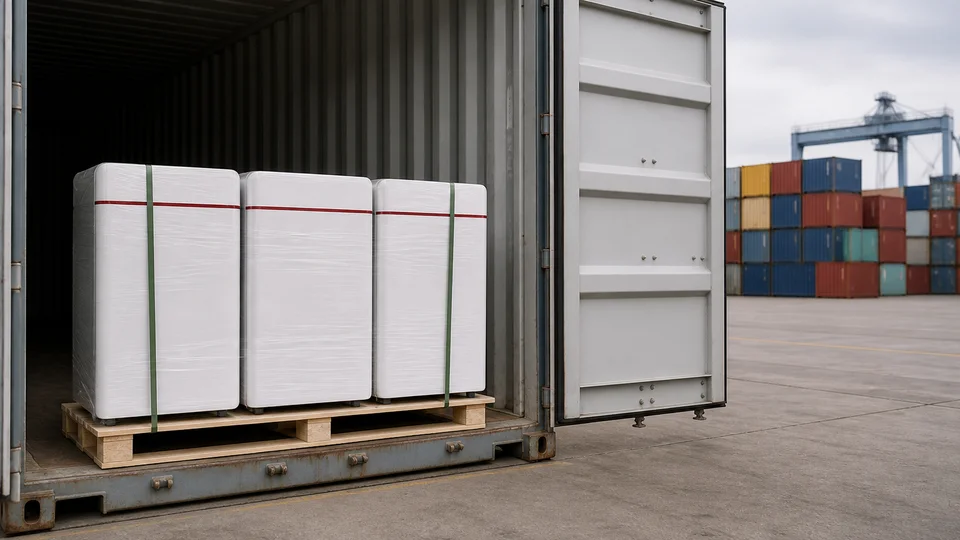
Why Home Batteries Ship by Sea, Not Air
The limit is watt-hours. Air cargo rules under the IATA dangerous goods provisions cap lithium batteries at 300 Wh for the standard clauses. A 5 kWh residential battery is sixteen times that ceiling. In other words, home battery shipping by air is out. As a result, the sea route is the only plan: standalone lithium ion batteries move under UN3480, and the IMDG code sets the handling rules for the voyage. This one fact removes most of the planning confusion, because there is only one route to schedule against.
So sea transit is slower than air. Then the shipment date is set by production plus booking, not by a flight. Your order tier, from sample to private label, decides when the line finishes. After that, the documents must be complete before the container is booked. However, a factory that books the box first and chases the papers later spends your money on demurrage. Your home battery shipping plan starts at the line, not at the port. The tiers and their dates are in our MOQ and lead time guide.
The Document Flow: What UN38.3 Actually Covers
In fact, UN38.3 is not a certificate you frame. Instead, it is a test series: altitude simulation, thermal cycling, vibration, mechanical shock, external short circuit, impact, overcharge and forced discharge. The battery design passes once. Then a short summary of that report travels with every shipment. Carriers and customs check the summary, not the full file. For the source, the UN Manual of Tests and Criteria defines the tests.
The Nine Documents per Order
The full set a buyer should hold per order looks like this:
| Document | What it proves | Issued by | When you need it |
|---|---|---|---|
| UN38.3 test summary | The design passed the eight transport tests | Factory, from the test lab | Before booking, every shipment |
| SDS with Section 14 | Transport classification and handling | Factory | With the DG declaration |
| Shipper’s DG declaration | The cargo is declared as UN3480 | Shipper or broker | Before loading |
| UN packaging certificate | The export pack meets UN38.3-class UN specification | Pack certifier | When UN-spec packaging is used |
| Commercial invoice and packing list | Value, quantity and cargo marks | Seller | For customs, both sides |
| Bill of Lading | The carrier’s contract of carriage | Carrier | After loading |
| Certificate of Origin | Where the goods were made | Chamber of commerce | When a trade scheme applies |
| ISF 10+2 (US entries) | Pre-arrival import data | Importer of record | 24 hours before loading |
| Insurance certificate | Cargo cover under CIF or DAP terms | Insurer | Before loading |
The Two Lines Buyers Misread
Two lines in that table, beside the UN38.3 flow, are usually misunderstood. First, the ISF is the importer’s own duty in the US. Your broker files it before the vessel loads in China, not after the ship arrives. Next, the certificate of origin matters when your market runs a trade scheme. Without one, it stays a formality. Meanwhile, the safety listings, UL 9540 and UL 1973, are market access, not transport. They sit beside the UN38.3 flow without replacing it, and they live in our home battery certifications guide.
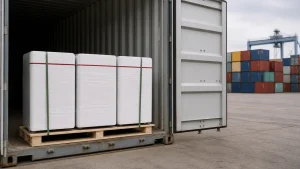
Packing and Loading: What a Battery Container Looks Like
First, batteries leave on export pallets, strapped, with the charge state set to the carrier limit. Air rules cap state of charge at 30 percent for the standard clauses. Ocean carriers commonly allow up to 50 percent, and your forwarder confirms the number for your route. Therefore, shipping at a higher charge looks like a saving, but it is not. A refused loading costs days, while the saved cycle costs almost nothing. Besides, the DG declaration names the charge state, so the number travels with the paperwork.
The loading plan is per model, because a container’s weight limit usually fills before its volume does. We send the loading plan with the quotation for every booking: units per 20-foot and per 40-foot high-cube, the pallet configuration, and the exact document set for your port. You bring the forwarder; we bring the numbers. In fact, a home battery shipping plan without a loading plan is a guess. Also, the manufacturer check includes whether a factory states its loading plan on request, before you order. Finally, a factory that cannot answer at quotation stage will not answer at loading stage.
Battery Import Ports, Transit Times and the Incoterm Line
Chinese export batteries leave mainly from Shenzhen, Shanghai and Ningbo for most home battery shipping routes. Next, typical transit windows move with the line and the season. For example, expect 18 to 25 days to the US West Coast. The US East Coast takes 30 to 38 days via the canal. Northern Europe runs 30 to 35 days, and Australia 12 to 18 days. So plan the purchase around the window. Then add a buffer for documentation and inspection. For a battery import, do not plan around the window alone.
Above all, the Incoterm decides where our job ends and yours begins. Under FOB, you control the carrier and the freight, and we load at the port of origin. Under CIF, we cover cost, insurance and freight to your port, and you handle import clearance. Under DAP or DDP, we deliver to your dock or door, and your broker and we manage the duty line together at booking. Tariffs on Chinese batteries change by year and by list. Therefore, your customs broker quotes the current rate for the battery import when the booking is made. Also, the right question for a factory is whether it has cleared your market before. In addition, the deal model, private label, ODM or OEM, changes who the importer of record looks like. Our OEM versus ODM guide covers that mapping.
Five Home Battery Shipping Mistakes That Detain a Container
The failures in this category are procedural, not mechanical. Fix the list, and the container moves:
- Booking the container before the UN38.3 summary and the SDS are on file. The port loads the boxes, and the paperwork never catches up.
- Declaring the cargo as ordinary goods. Then the carrier refuses a concealed dangerous goods load, fines it and forces a re-declaration, with the sailing already lost.
- Missing the ISF deadline on a US booking for your battery import. You file it before loading in China, not after arrival.
- Shipping at a charge state above the carrier cap to save a charging cycle. The refused loading costs more than the cycle.
- Skipping the written document set at quotation. A verbal promise never appears in the customs file.
Above all, every item on this list is caught in the first email exchange, before the UN38.3 summary and the SDS are on file. For any home battery shipping order, checking costs one afternoon. Skipping the check costs a container sitting at the port.
Frequently Asked Questions
Can LiFePO4 home batteries be shipped by air?
No, not in normal cargo. Air provisions cap lithium batteries at 300 Wh, and a 5 kWh battery is sixteen times that. So everything moves by sea under UN3480, with a proper DG declaration.
Is UN38.3 a certificate or a test report?
A test report. The design passes the eight-test series once, and the summary ships with every container. However, it does not certify installation safety. That is what UL 9540 or IEC 62619 cover.
Who files the ISF for a US battery import?
The importer of record does, through a customs broker, at least 24 hours before the vessel loads in China. If you buy FOB, you file it. A late ISF holds the cargo or triggers penalties.
What state of charge should the batteries ship at?
In particular, whatever your carrier caps for the route. Thirty percent is the air rule and a common ocean ceiling, and some carriers allow 50. We state the number in the shipping notice and the DG declaration.
Does UL 9540 affect shipping?
Not the transport itself. UL 9540 is market access for the installed system. In addition, some customs desks ask for the listing at clearance, so keep the file ready next to the UN38.3 summary. The UN set moves the container.
What if the container is held for inspection at destination?
With a correct DG declaration and complete documents, the inspection stays routine. The painful holds come from missing papers. So every home battery shipping order confirms the document set, led by the UN38.3 summary, in writing before booking.
Bottom Line
In conclusion, home battery shipping is a documents problem that looks like a freight problem. The battery cannot fly, so the plan is sea, UN3480, and a nine-line document set finished before the booking. The carrier sets the state of charge. The Incoterm sets the border between our jobs. Treat the transit window as a floor, not a promise. RUIDASIMAI is a residential home battery manufacturer that ships from China under a standard UN38.3 document package for every order. Finally, send your destination port, model and quantity. We reply in writing with the document set, the loading plan and the windows to plan around.
Shipping check
Want your container plan confirmed in writing?
Send us your destination port, model and quantity. We reply with the UN38.3 document set, the loading plan and the transit windows to plan around.
- Destination port and target Incoterm (FOB / CIF)
- Model, quantity and timeline
- Your forwarder, if you already have one
Prefer email? Write to admin@rdsmod.com