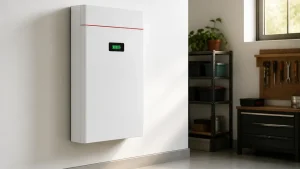
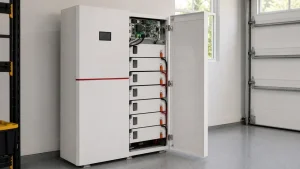
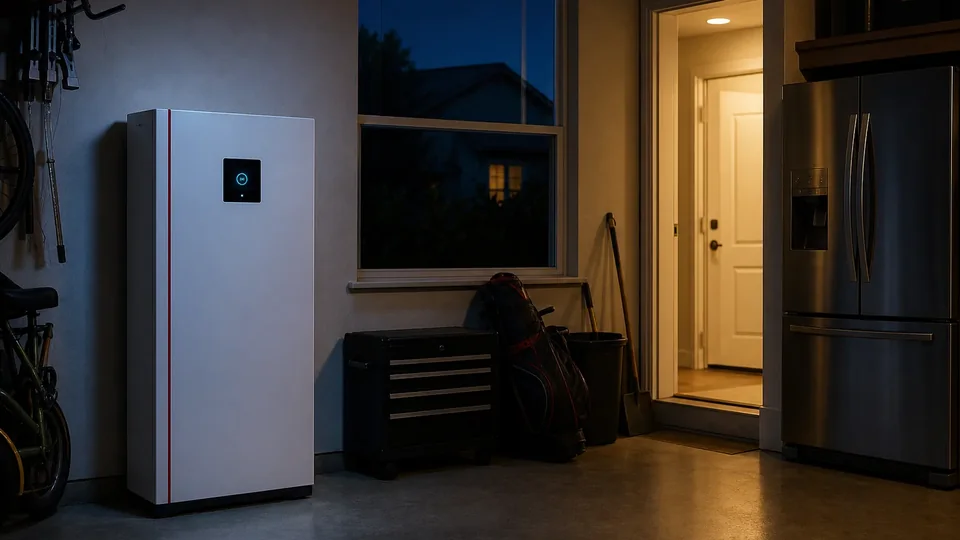
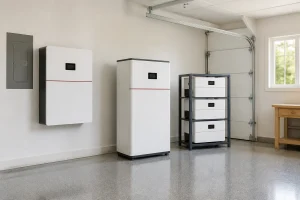
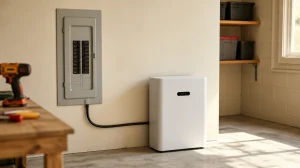
A home battery without solar can still be useful because the battery does not need solar panels to charge. It can charge from the utility grid during lower-cost periods, then discharge when electricity is more expensive or when the grid goes down. For some homeowners, that makes a battery a useful energy-management and backup-power device even before solar is installed. The key question is not whether a battery works without solar. It does. The real question is whether the electricity-rate structure, backup requirements, battery size, and installation cost make the system worthwhile for your home.
Can You Install a Home Battery Without Solar?
Yes. A residential battery energy storage system can operate as a stand-alone system connected to the utility grid.
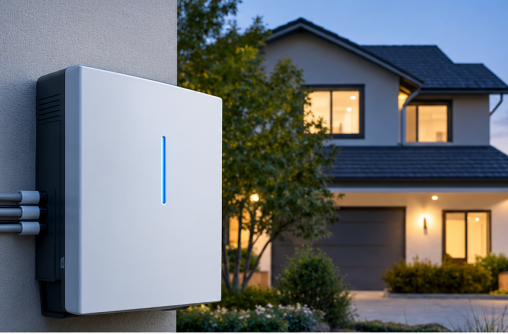 The basic operating cycle is simple:
- The battery charges from the grid.
- It stores that electricity on site.
- During selected peak-price periods, the battery discharges.
- Then the inverter supplies power to the home or selected backup circuits.
- The battery can recharge when electricity prices fall again.
This is different from a solar-plus-storage system, where solar panels provide some or all of the charging energy.
The U.S. Department of Energy describes energy storage as a way to capture electricity and release it later when demand or system conditions make that useful. DOE also notes that storage can stand alone or be paired with solar.
Therefore, adding solar is not a technical requirement for residential battery storage.
However, removing solar changes the economics. A grid-charged battery buys electricity before storing it, so the system must create enough value through rate shifting, backup power, demand management, or other services to justify its cost.
How Does a Battery Work Without Solar?
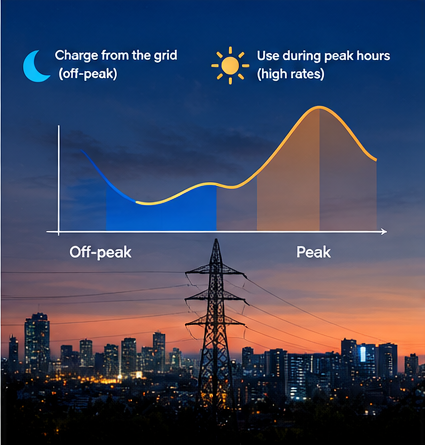 Without solar, the battery is essentially a controllable energy reservoir.
Suppose a utility charges $0.12/kWh overnight and $0.35/kWh during a peak period. A properly configured battery can charge during the cheaper period and discharge during the expensive period.
The theoretical price difference is:
$0.35 − $0.12 = $0.23/kWh
But that $0.23 is not the battery’s actual savings.
Charging and discharging cause energy losses. The battery also has installation costs, inverter losses, operating limits, degradation, and financing or maintenance costs. Some utilities also apply fixed charges that a battery cannot eliminate.
DOE’s guidance on utility rates separates energy charges, demand charges, and fixed charges. Time-based energy rates can create opportunities to shift electricity use from high-cost periods to lower-cost periods, while fixed charges generally remain regardless of consumption.
That distinction matters.
A battery can move energy consumption between hours. It cannot automatically eliminate every part of an electric bill.
When Does a Home Battery Without Solar Make Sense?
A grid-charged battery becomes more relevant when your electricity tariff rewards time shifting or when backup power has significant value to you.
1. Your utility uses time-of-use pricing
Time-of-use, or TOU, pricing charges different electricity rates at different times.
For example, electricity may be cheaper overnight and more expensive during afternoon or evening peaks. DOE describes time-variable pricing as a widespread rate structure in which electricity prices can vary by time of day and season.
In that situation, a battery can charge during a low-cost period and discharge during a high-cost period.
The larger the usable price spread, the more potential value exists from energy shifting.
Still, compare the spread with battery efficiency and system costs before assuming that the arbitrage will pay for the battery.
2. You need backup power
A battery does not have to save money every day to provide value.
If outages are frequent or the home contains important loads, backup capability may be the primary reason for installation.
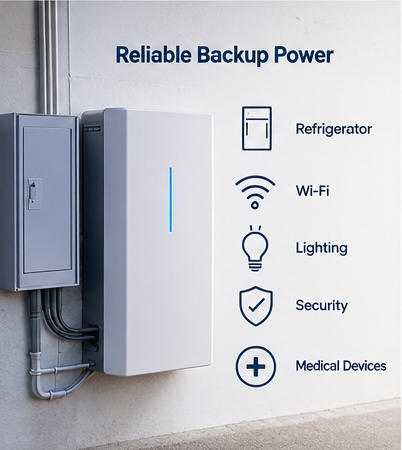
A properly designed system can keep selected circuits running when the utility supply fails. These may include:
- Refrigerators
- Internet equipment
- Lighting
- Security systems
- Medical equipment where permitted and properly designed
- Heating or cooling equipment
- Garage doors
- Selected kitchen circuits
The important point is that battery energy capacity and battery power capacity are different specifications.
A battery may store 10 kWh but have a limited continuous output. A high-power appliance can therefore exceed the inverter’s output even when plenty of energy remains in the battery.
3. You want to add solar later
A battery can also be part of a staged energy strategy.
Some homeowners may install storage first and add solar later. This can make sense when the immediate priority is backup power or when the homeowner wants to spread project costs over time.
The important requirement is compatibility.
Before buying a battery, check whether the inverter, communication system, transfer equipment, and controls can support the planned future configuration. Otherwise, adding solar later may require additional equipment.
When Is a Home Battery Without Solar Less Attractive?
The economics are weaker when electricity prices are nearly the same throughout the day.
If the battery charges at almost the same price at which it later discharges, there is little room for energy arbitrage.
The calculation becomes even less attractive after accounting for efficiency losses.
For example, imagine a battery takes 10 kWh from the grid but only returns 9 kWh to the home after conversion losses. The homeowner has paid for 10 kWh but receives 9 kWh of usable energy.
This means the required price spread must be larger than a simple peak-rate minus off-peak-rate calculation suggests.
A battery may also have limited financial value when:
- Outages are extremely rare.
- Backup loads are small.
- Electricity rates are mostly flat.
- The home has large fixed utility charges.
- The battery is significantly oversized.
- Installation costs are high.
- The system cannot participate in available utility programs.
The right evaluation should therefore use your actual utility tariff and household load profile rather than a generic payback estimate.
How Big Should a Home Battery Be Without Solar?
 Battery sizing should start with the loads you actually want to support.
Two numbers matter:
Energy capacity, measured in kWh: how much electricity the battery can store.
Power capacity, measured in kW: how much power the system can deliver at a given time.
NREL’s residential battery cost model treats both power and energy capacity as important system-cost variables. Its 2024 representative residential storage system is 5 kW / 12.5 kWh, but that is a modeling reference rather than a recommended size for every home.
For a backup-focused system, calculate the expected load first.
For example:
| Load | Approx. Power | Runtime |
|---|---|---|
| Refrigerator | 200 W | 24 h |
| Wi-Fi/router | 30 W | 24 h |
| Lighting | 150 W | 6 h |
| Television | 100 W | 4 h |
| Small appliances | 300 W | 2 h |
The battery should then be sized around the actual energy requirement and peak power demand.
Do not size a battery only from the home’s monthly electricity consumption. Monthly kWh tells you how much energy the home uses overall. It does not tell you which loads must operate during an outage or how much power they need simultaneously.
What Battery Chemistry Should You Use?
For residential stationary storage, lithium-ion batteries are widely used. NREL’s residential storage modeling includes both NMC and LFP chemistries and identifies LFP as the primary chemistry for stationary storage in its modeled technology set.
For homeowners and system designers, chemistry should be considered together with:
- Usable capacity
- Cycle life
- Operating temperature
- Continuous power
- Peak power
- BMS functions
- Enclosure design
- Warranty
- Installation environment
- Safety certification
For a home battery without solar, daily cycling may be important when the system is used for TOU arbitrage. Therefore, comparing only nominal capacity is not enough.
A 10 kWh battery with different usable capacity, efficiency, cycle limits, and warranty conditions can deliver very different long-term value.
What Safety Certifications Should You Check?
Residential energy storage should be evaluated as a complete energy storage system, not just as a box of battery cells.
UL Solutions notes that residential energy storage systems are subject to installation-code and safety requirements, including UL 9540 certification for residential ESS applications in relevant contexts. UL also discusses UL 9540A testing for thermal runaway and fire-propagation behavior.
Before purchasing, verify:
- The applicable product certification
- Certification scope
- Battery chemistry
- Inverter certification
- BMS protection functions
- Thermal management
- Enclosure rating
- Installation requirements
- Local electrical-code requirements
- Warranty conditions
- Approved installation configurations
Certification should be checked against the actual product model and intended installation configuration.
A certificate for a related product is not the same as certification for the system you are buying.
Can a Grid-Charged Battery Provide Backup Power?
Yes, but backup operation requires more than simply connecting a battery to the home.
The system normally needs appropriate power electronics and a method to isolate the home from the utility grid during an outage.
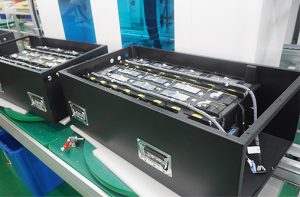
This is why buyers should distinguish between a battery module and a complete residential energy storage system.
A complete system may include:
Battery → BMS → inverter → transfer/isolation equipment → home loads
The inverter must also support the required continuous and surge power.
For example, a refrigerator compressor or HVAC system may have a starting surge that is considerably higher than its normal running power. The system therefore needs enough instantaneous power to start the load.
For backup applications, specify the loads that must remain powered rather than simply asking for the largest battery available.

Can the Battery Participate in Demand Response?
Potentially, depending on the utility, location, equipment, and program rules.
Demand response allows customers or aggregated energy resources to change electricity consumption in response to grid conditions or price signals. DOE identifies energy storage as one resource that can support these types of grid services.
A residential battery may therefore provide value beyond personal electricity arbitrage.
However, program availability is highly location-specific. Participation may also require compatible communications, controls, aggregation, or utility approval.
Do not include projected demand-response revenue in a purchase calculation until the actual local program has been verified.
Home Battery Without Solar: What Should Buyers Ask a Manufacturer?
For a factory or OEM supplier, the important questions go beyond nominal battery capacity.
Ask for the complete technical specification, including:
- Usable energy: What is the guaranteed usable kWh?
- Continuous output: How many kW can the system deliver continuously?
- Peak output: What surge power is available, and for how long?
- Cycle conditions: What conditions support the stated cycle-life figure?
- Cell chemistry: Is the system LFP, NMC, or another chemistry?
- BMS: What protections and monitoring functions are included?
- Operating temperature: What are the charging and discharging limits?
- Certification: Which exact model has been tested and certified?
- Backup operation: Which loads can the system support during an outage?
- Expansion: Can additional battery modules be added later?
- Communication: Which inverter and energy-management protocols are supported?
- Warranty: What capacity retention and operating conditions are guaranteed?
A reliable specification should connect the battery cells, BMS, inverter, enclosure, thermal management, and control system into one documented system.
Is a Home Battery Without Solar Worth It?
A home battery without solar can be worthwhile when it solves a specific energy problem.
The strongest use cases generally involve a combination of time-of-use electricity rates, meaningful peak/off-peak price differences, backup-power requirements, or participation in applicable grid programs.
It is less compelling when electricity prices are flat and backup needs are minimal.
The calculation should therefore start with your utility tariff and load profile, not with the battery’s advertised capacity.
For homeowners considering a future solar installation, compatibility should also be checked before purchasing. A battery selected today should not create unnecessary replacement costs when the energy system expands later.
For manufacturers and system integrators, the same principle applies: design the battery around the actual operating scenario. Capacity, power, BMS, thermal management, inverter compatibility, certification, and communication functions all affect whether a residential storage system performs as expected.
Energy storage does not require solar to provide useful functions. Solar simply adds another charging source. Without solar, the grid becomes the charging source, and the value of the battery depends on how effectively that stored electricity can be shifted, controlled, or reserved for backup.
Frequently Asked Questions
Can you install a home battery without solar?
Yes. A residential battery can operate as a stand-alone system connected to the utility grid. It charges from the grid during lower-cost periods and discharges during higher-cost periods or during an outage, without requiring solar panels.
How does a battery without solar actually save money?
It charges when electricity is cheaper and discharges when electricity is more expensive, a practice sometimes called time-of-use arbitrage. The actual savings are smaller than the simple price difference because of charging and discharging losses, installation costs, and any fixed utility charges that the battery cannot eliminate.
When does a grid-charged battery make the most sense?
It makes the most sense when your utility uses time-of-use pricing with a meaningful peak/off-peak price spread, when backup power has significant value to you, or when you plan to add solar later and want to stage the investment.
When is a home battery without solar less worthwhile?
It is less attractive when electricity prices are nearly flat throughout the day, when outages are rare, when backup loads are small, or when fixed utility charges make up a large share of the bill, all of which shrink the arbitrage opportunity.
How should I size a battery if I don’t have solar?
Size it around the loads you actually want to support during an outage, not around your home’s total monthly electricity use. Two numbers matter: the usable energy capacity in kWh, and the continuous power capacity in kW that determines what the system can run at once.
Can a grid-charged battery still provide backup power during an outage?
Yes, but it requires the right power electronics and equipment to isolate the home from the utility grid, not just a battery connected to the house. The inverter also needs enough continuous and surge power to start and run the intended backup loads.
Can a standalone battery participate in demand response programs?
Potentially, depending on the utility, location, and program rules. Participation may also require compatible communications, controls, and utility approval, so program availability should be verified locally before counting on this as a value source.
Engineering support
Is a battery without solar worth it for you?
Send us your tariff and your outage history. Our engineers check the standalone storage case for your bills and confirm when it pays for itself.
- Current tariff rates, day and night
- How often and how long outages last
- Any planned solar installation in the future
Prefer email? Write to admin@rdsmod.com